
Are you tired of signing endless smart contract approvals, burning capital on multi-hop bridge gas fees, and living in constant fear of a sudden KYC hold freezing your funds mid-swap? In 2026, navigating cross-chain liquidity shouldn’t feel like walking through a regulatory and technical minefield.
If you are looking for an execution layer that guarantees minimum slippage without forcing you to compromise your personal data or wallet security, you are in the right place.
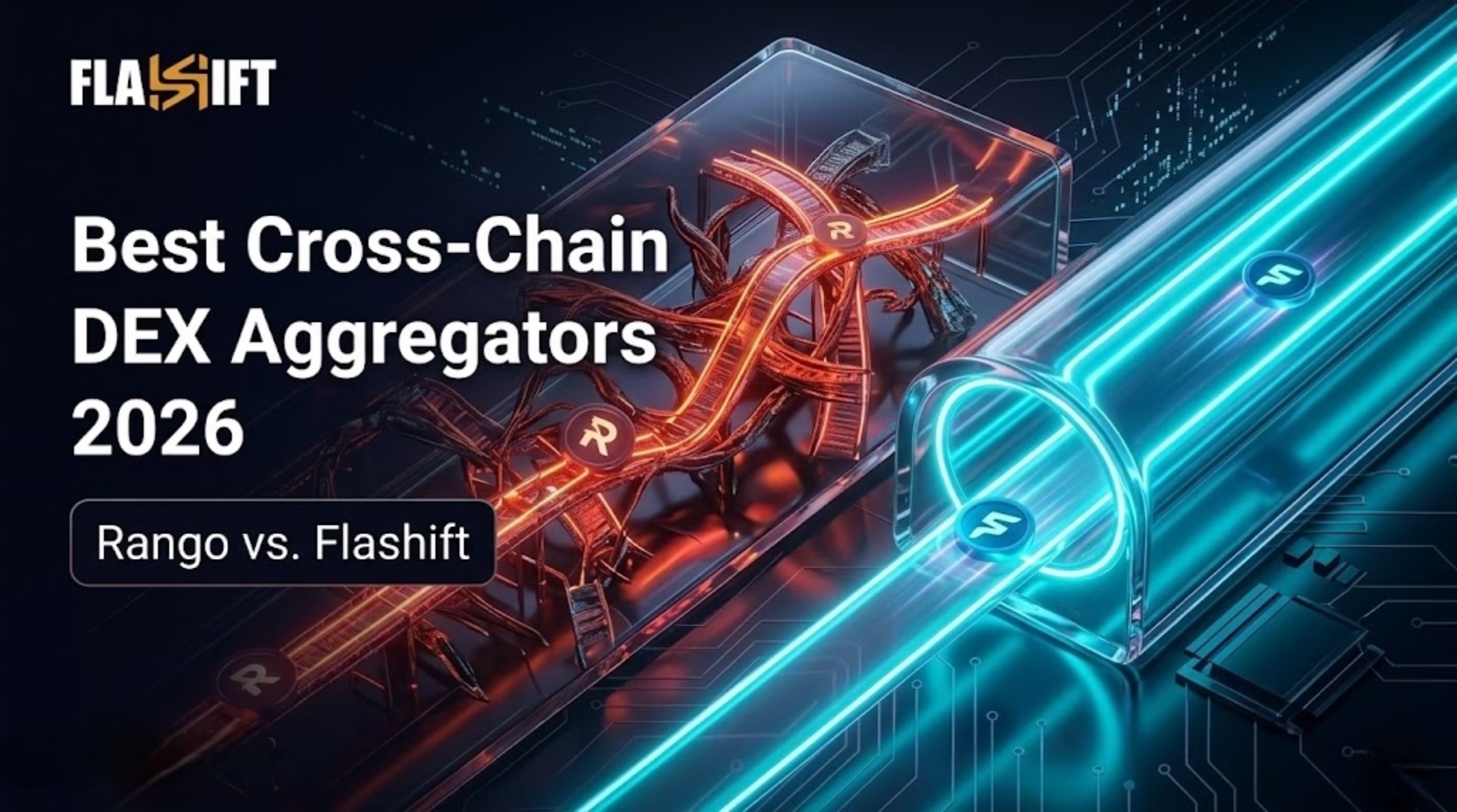
In this definitive guide, we compare the top two contenders in cross-chain routing, Rango Exchange and Flashift, to help you execute faster, cheaper, and safer swaps across disparate blockchains.
Rango vs Flashift: Feature Comparison
To evaluate how these platforms perform under real-world trading conditions, we must analyze their core architecture across security, privacy, routing methodology, and fee transparency.
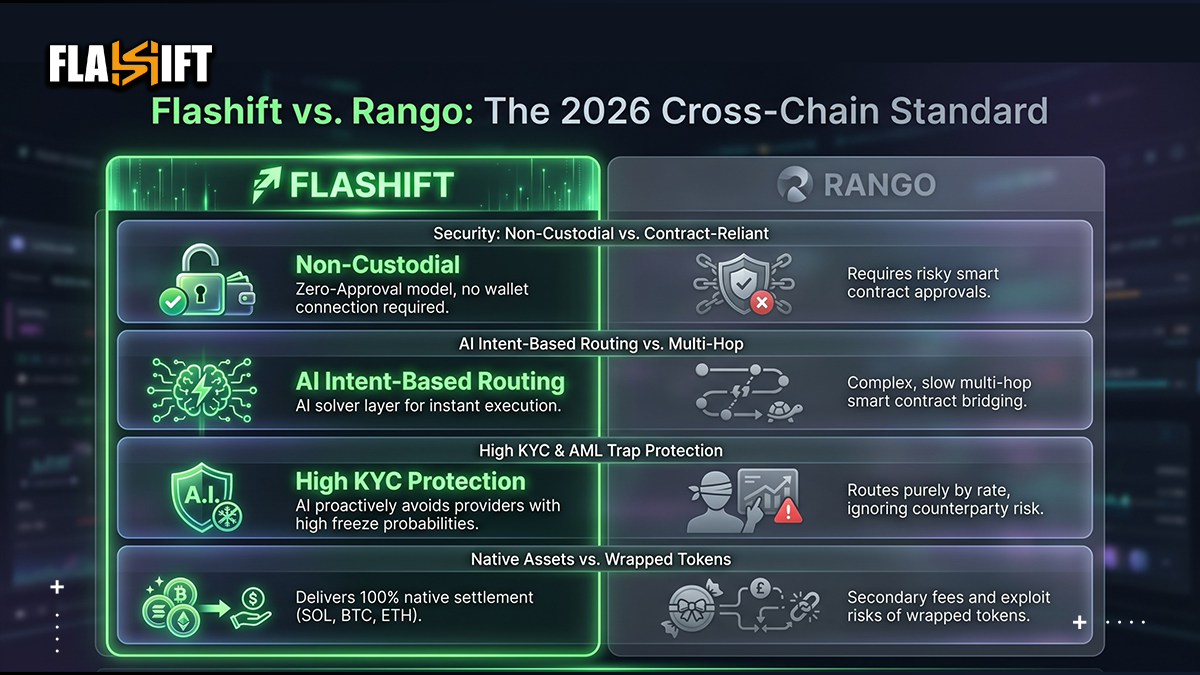
| Feature / Criteria | Rango Exchange | Flashift (AI Aggregator) |
| Security Model | Contract-reliant (Requires dApp wallet connections & ERC-20/SPL approvals) | Non-Custodial & Zero-Approval (Direct wallet-to-provider execution via deposit addresses) |
| Wallet Connection Required? | Yes (Must sign transactions & approve contract allowances via MetaMask/Phantom) | No (Zero-connection architecture; send funds to a single-use deposit address) |
| Routing Methodology | Multi-hop smart contract bridging | AI Intent-Based Routing & Solver Layer (Aggregates instant exchanges & DEX liquidity) |
| Fee Transparency | Mixed (Visible bridge fees, but hidden LP slippage & MEV exposure across hops) | 100% Transparent (All-inclusive quotes with proactive AI bait-and-switch filtering) |
| KYC / AML Trap Protection | Low (Routes mechanically to raw best rate, ignoring counterparty KYC risk) | High (AI continuously tags and avoids providers with high KYC-hold probabilities) |
| Asset Output | Often delivers wrapped tokens requiring secondary unwrapping swaps | Direct native settlement (SOL, BTC, ETH) |
Which Aggregator Has Lower Fees?
When evaluating the cost of a cross-chain swap, novice traders often look solely at advertised exchange rates. In real-world multi-chain execution, the true cost is driven by practical operational factors rather than theoretical math: baseline protocol fees, multi-hop gas consumption across separate network layers, execution slippage during high volume, and hidden aggregator markups.
Practical Breakdown of Gas, Slippage, and Hidden Costs
- Multi-Hop Gas Accumulation:
Rango’s multi-hop model forces the user to execute multiple state changes across distinct blockchains (approvals, swaps, bridge deposits, and claims). In a moderate network congestion environment, these cumulative steps can easily consume heavy execution gas. Conversely, Flashift utilizes a zero-approval, intent-based deposit architecture. You execute a single native transfer to a generated non-custodial address, eliminating contract approval and claim costs entirely.
- The Slippage Reality:
In traditional automated market maker (AMM) routing, slippage scales relative to order size versus pool liquidity. When routing large blocks through fragmented pools, trades suffer price impact at every single hop. Flashift’s AI engine mitigates this by routing high-volume trades through off-chain intent solvers and high-depth institutional liquidity pools, enforcing strict slippage thresholds.
- Exposing Hidden Aggregator Fees:
Many aggregators advertise zero platform fees while quietly utilizing “bait-and-switch” pricing models. They display a highly competitive upfront rate, but deliver a lower output post-execution, pocketing the difference.
Flashift’s AI engine continuously audits post-trade settlements across all partner exchanges. If a liquidity provider demonstrates pricing drift, the AI automatically downgrades its ranking, ensuring that the quote you see is the exact capital delivered to your destination wallet.
The No-KYC Advantage & Financial Sovereignty
In 2026, privacy is no longer about hiding; it is about Financial Sovereignty. Surrendering highly sensitive identification documents (passports, selfies, proof of address) just to rebalance a crypto portfolio creates massive, centralized honeypots of personal data that are routinely breached and leaked.
Furthermore, traditional platforms that blindly route trades based purely on price often fall into the AML Trap. If a route selects a provider that uses aggressive, automated risk-scoring algorithms, your assets can be instantly frozen mid-swap, demanding an invasive identity verification process to release your funds.
Flashift solves this through its AI-Driven Risk Tagging Engine:
- Real-Time Data Analysis: The AI tracks hundreds of post-trade parameters across all partner exchanges.
- Proactive Protection: If a specific provider starts exhibiting an anomalous rate of post-deposit KYC holds or sudden operational freezes, Flashift’s AI detects the pattern instantly and reroutes your trade away from that provider—even if they flash the cheapest upfront rate.
- True Non-Custodial Sovereignty: By eliminating user accounts, database logging, and smart contract connections, you maintain 100% control over your digital assets at every stage of the execution lifecycle.
Step-by-Step: Executing Zero-Approval Cross-Chain Swaps
Executing a seamless, non-custodial cross-chain swap on Flashift takes less than 3 minutes and requires zero wallet approvals:
- Access the Interface: Navigate to flashift.app. No account creation, login, or wallet connection is required.
- Configure Your Asset Pair & Amount: Select your source token (e.g., ETH on Ethereum) and target token (e.g., SOL on Solana). Enter the volume you wish to exchange.
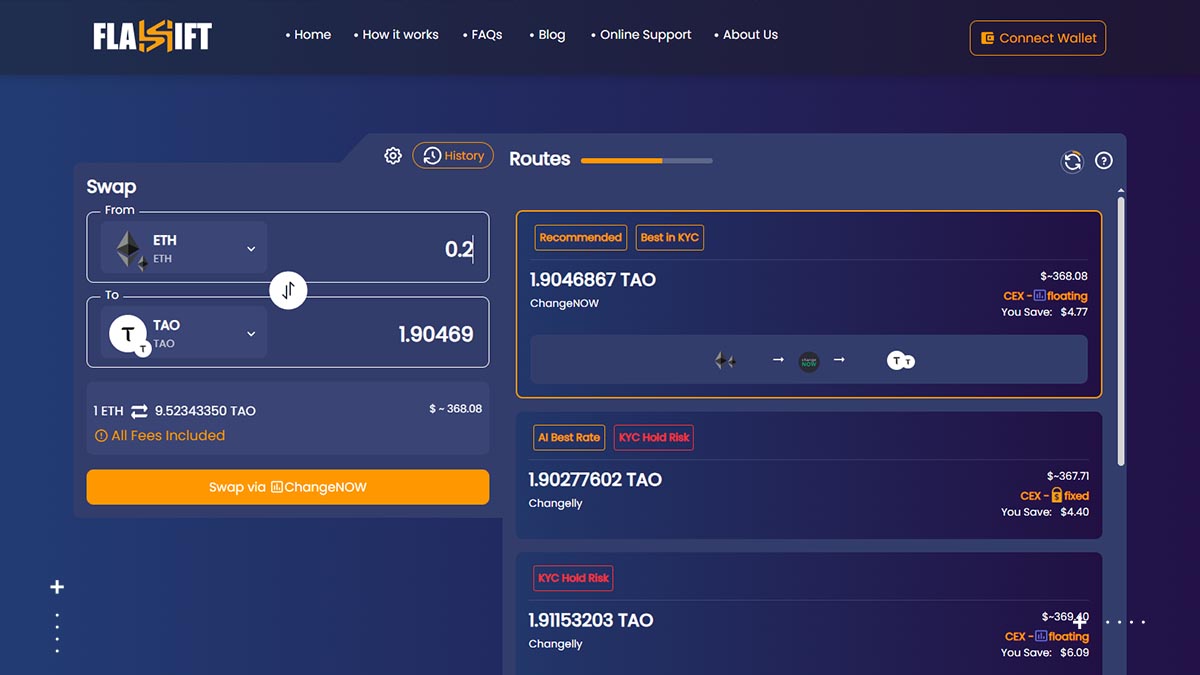
- Review AI-Optimized Routes: Flashift’s AI engine instantaneously scans dozens of liquidity providers and displays the optimal route based on net output, payout reliability, and privacy-preserving execution. Routes tagged with “AI Best Rate” or “Recommended” ensure maximum safety and minimum price impact.
- Enter Your Destination Wallet Address: Paste your native target wallet address (e.g., your Phantom wallet address for SOL). Double-check the character string.
- Deposit Funds: Flashift generates a unique, single-use non-custodial deposit address. Send the exact amount of source asset from your personal wallet to this address.
- Automated Settlement: Once the source network registers block confirmation, Flashift’s routing engine executes the swap and deposits native assets directly into your target wallet within 2 to 5 minutes.
FAQ
- How does Flashift achieve cross-chain swaps without requiring wallet connections?
Flashift operates as a Chain Abstraction Layer that utilizes non-custodial, single-use deposit addresses. You simply perform a standard, native transaction from your wallet to the generated execution address. This eliminates all dApp approval risks and keeps your primary wallet completely isolated from contract vulnerabilities.
2. What is the difference between “Fixed Rate” and “Floating Rate” swaps?
A Fixed Rate swap locks in the exact exchange rate displayed at the time of order creation, protecting you entirely from market volatility during block confirmation times (ideal during high market fluctuations). A Floating Rate swap adjusts dynamically with live order book fluctuations until the transaction is confirmed on-chain, often offering lower baseline fees during stable market conditions.
- What happens if a liquidity provider triggers an unexpected transaction delay or KYC hold?
If you route through basic platforms, a stuck transaction often leaves your capital stranded indefinitely. Flashift mitigates this through a dual-layered system: first, its predictive AI actively avoids providers with high KYC-hold or delay metrics. Second, Flashift backs its automation with 24/7 dedicated live technical support. If an anomaly occurs on the provider network, Flashift’s team actively coordinates behind the scenes to resolve the bottleneck or safely return the non-custodial deposit directly to your wallet.
- Why is receiving Native Assets superior to receiving Wrapped Tokens (wETH, wBTC)?
Wrapped tokens are synthetic representations of assets minted by third-party smart contract bridges. They introduce two major risks: Contract Exploit Risk (if the bridge holding the underlying collateral is hacked, your wrapped token becomes worthless) and Friction Risk (you must execute secondary swaps and pay additional gas fees to convert wrapped tokens into native assets). Flashift ensures 100% native settlement directly into your target blockchain address.