

Can you still cash out Bitcoin in Europe without triggering a wall of identity checks? In 2026, the answer is no longer found in legal loopholes, but in understanding how transactional tracking is architected.
With the full implementation of the Markets in Crypto-Assets Regulation (MiCAR) and the recast Transfer of Funds Regulation (TFR), the EU has permanently shifted the boundaries of transactional privacy.
This guide outlines how the regulatory landscape operates in 2026, provides a country-by-country breakdown of actual ATM limits, and explains how to manage your privacy legally before utilizing a physical exit gateway.
Bitcoin ATM Rules & Limits by Country (2026 Overview)
The regulatory enforcement across European jurisdictions remains uneven, though the gap is rapidly closing. Below is the operational reality of physical cash-outs across key European markets:
| Country | 2026 Regulatory Status | Typical Operator Limit | Practical Impact on Users |
| Germany | MiCAR licensed; BaFin regulated | Zero-tolerance policy | Full identity verification required for all transaction sizes. |
| Spain | Rigid enforcement under MiCAR | €1,000$ limit | Phone or ID verification is mandatory; light KYC is being phased out. |
| France | Strict AML/CFT enforcement | €250 to €50 caps | Identity checks are applied to almost all meaningful cash-outs. |
| Italy | Post-transitional enforcement | €1,000 cap | Tightening limits; the italy crypto atm market has moved entirely to KYC. |
| Romania | Aligning with TFR standards | €1,000 cap | Local withdrawal limits (limita retragere atm bitcoin) require ID registration. |
| Netherlands | High-compliance environment | Strict Zero-KYC exclusion | No transaction can be completed without verified documentation. |
Does EU AMLR Require KYC for Every Bitcoin Transaction?
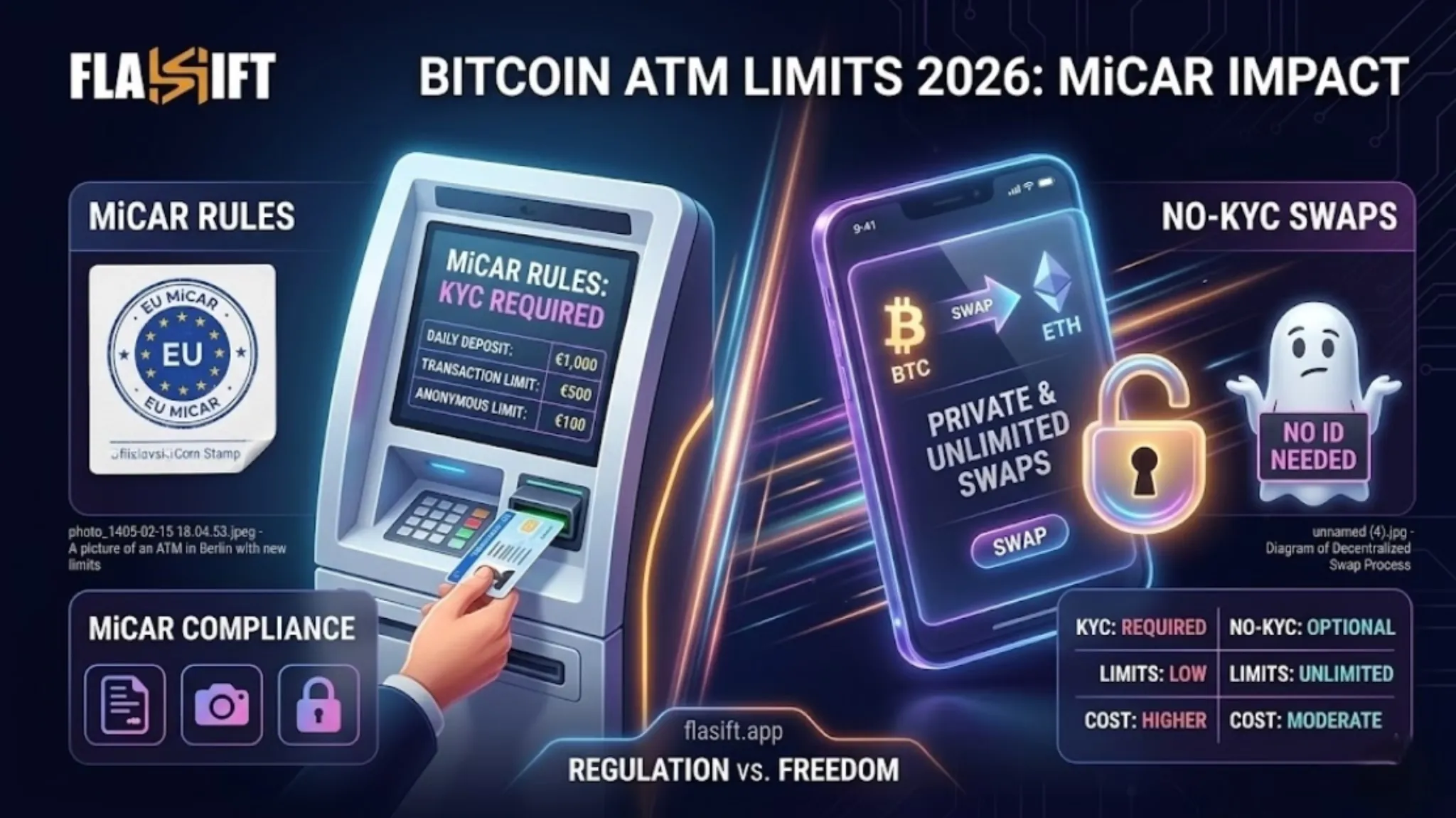
Regarding the scope of the EU Anti-Money Laundering Regulation (AMLR), we must separate on-chain peer-to-peer movements from service-provider transactions.
- Pure P2P Transactions: The EU AMLR does not require identity verification or KYC for private transactions occurring strictly between two self-hosted (unhosted) wallets. If you send Bitcoin from your private hardware ledger directly to another individual’s ledger, this transaction remains outside the regulatory scope of Crypto-Asset Service Providers (CASPs).
- The Zero-Threshold TFR Rule (Crypto-to-CASP): The moment your transaction interacts with a regulated gateway, such as a centralized exchange, a payment processor, or a Bitcoin ATM, all privacy exemptions vanish. Under the EU Transfer of Funds Regulation (TFR), there is no de minimis threshold for crypto-assets. While traditional wire transfers under €1,000 allow for simplified compliance, every single cryptocurrency transaction touching a CASP requires full originator and beneficiary data, regardless of the transaction size.
- Self-Hosted Wallet Verification: If you transfer cryptocurrency valued at €1,000 or more to or from a self-hosted wallet using a regulated CASP, the service provider is legally mandated to verify that you own or control that self-hosted wallet.
The Myth of the “No-ID” Bitcoin ATM in 2026
The transition periods for ATM compliance under MiCAR have concluded, reshaping how these physical kiosks operate.
The “€990 Limit” is Operational, Not Legal
Many operators historically advertised a limit—typically around €990 per day—under which users could buy or sell crypto with only a phone number or partial verification. In 2026, this limit is purely an operational risk-management threshold set by independent operators, not an official legal buffer.
Under MiCAR, because Bitcoin ATMs are classified as CASPs, they must enforce robust identity verification standards. While some operators in lenient jurisdictions might still tolerate small-scale transactions under basic verification, regulatory scrutiny has made strict KYC the default standard. Attempting to bypass these requirements via unlicensed kiosks carries massive systemic risks: regulatory authorities in Germany recently seized over €250,000 in cash and shut down 13 unlicensed terminals operating outside of national BaFin authorizations.
Bitcoin ATM Rules & Limits by Country (2026 Overview)
The regulatory enforcement across European jurisdictions remains uneven, though the gap is rapidly closing. Below is the operational reality of physical cash-outs across key European markets:
Strategic Rebalancing: Pre-Swapping via Non-Custodial Channels
If your objective is to maintain structural privacy on-chain before executing a physical withdrawal, routing your transactional history through centralized order books is a critical vulnerability. Centralized exchanges log your IP address, deposit history, and KYC metadata, linking your physical identity directly to your historical blockchain footprint.
To preserve transactional sovereignty, professional allocators execute their asset conversions on-chain prior to interacting with a fiat off-ramp.
By utilizing decentralized cross-chain liquidity aggregators, you can swap highly visible assets like Bitcoin or Ethereum into the precise stablecoin pair (e.g., USDT or USDC) that your local physical off-ramp supports. This process is executed strictly wallet-to-wallet:
[Visible On-Chain Asset: BTC/ETH] ──► [Non-Custodial Multi-Chain Aggregator]
(Zero Database Tracking) ▼
[Secure Target Asset: Stablecoin] ─► [Compliant Local Cash-Out Gateway]
Because this routing framework functions strictly as a pure technology layer, there are no centralized databases, no proprietary custody vaults, and zero locked liquidity pools (Custody Pools). The systemic risks of database leaks, identity exposure, and smart-contract exploits are effectively eliminated. Your assets remain 100% non-custodial throughout the entire swap journey, keeping you in complete control of your keys.
Once your portfolio is balanced into stable assets, you can approach your local compliant gateway with a clean, single-source transaction, satisfying necessary KYC requirements for the physical cash withdrawal without exposing your historical trading records.
Comparative Evaluation of Cash-Out Routes (2026)
Choosing the right off-ramp requires balancing speed, fees, and privacy thresholds.
| Route Option | KYC Mandate | Privacy Level | Settlement Velocity | Typical Fee Structures | Best Suited For… |
| Bitcoin ATM | Yes (Virtually Always) | Low to Moderate | Medium | 5\% to 10\% | Small, immediate cash withdrawals. |
| Centralized Exchange (CEX) | Yes (Strict) | Low | Fast (Bank transfer latency) | 0.1% to 1.5% | Standard bank-account payouts. |
| P2P / OTC Desk | Yes (MiCAR Licensed) | Moderate | Variable | Negotiated | Large-scale, off-market portfolio adjustments. |
| No-KYC Crypto Swap | No (Crypto-only) | High (On-Chain) | Near-Instant | Low to Medium | Private portfolio rebalancing and wallet-to-wallet transfers. |
| Fintech Payment Cards | Yes | Low | Instant | 1.5% to 3.5% | Everyday debit card transactions. |
To protect your positions from sudden price swings while searching for the most cost-effective cash-out route, always ensure your liquidity paths are audited. You can check real-time routing rates and prevent excessive slippage across multiple blockchain networks using advanced on-chain analysis before confirming your trades.
Step-by-Step Compliance & Privacy Protocol
- Analyze Local Thresholds: Identify the specific compliance requirements and verification limits of the ATM or exchange operator in your target European country.
- Verify Your Assets Natively: Use multi-chain swap engine to consolidate or convert your volatile crypto-assets directly into the target stablecoin or fiat-pegged asset required by your destination off-ramp.
- Execute the On-Chain Migration: Ensure your exchange is handled via a non-custodial cryptocurrency exchange layer to prevent your private wallet addresses from being linked to a centralized database prior to withdrawal.
- Complete the Off-Chain Withdrawal: Interact with your selected compliant, licensed ATM or fiat off-ramp. Complete the required identification verification process knowing that your broader transaction history and cold-storage balances remain private and insulated.
FAQ
Can I still find a Bitcoin ATM in Europe that does not require ID?
In 2026, finding an ATM with zero identity verification is virtually impossible. Under MiCAR and TFR rules, operators must enforce KYC compliance. Kiosks that attempt to bypass these rules operate illegally and face immediate seizure by national regulators.
Does the EU AMLR ban self-custody wallets?
No. Self-hosted wallets (like Ledger, Trezor, or MetaMask) are entirely legal in the EU. The regulation only mandates that when a self-hosted wallet interacts with a regulated CASP, the provider must identify the user and verify wallet ownership if the transaction value is €1,000 or more.
How does the Travel Rule affect small transactions?
Unlike conventional wire transfers, the TFR has a zero-threshold policy for crypto-assets. Every single crypto transaction involving a regulated service provider requires full originator and beneficiary data, regardless of how small the transaction amount is.
What is the best way to handle privacy-focused crypto transactions in the EU?
Keep your crypto-to-crypto trading entirely on-chain using non-custodial, peer-to-peer protocols that do not require sign-ups or identity verification. Only utilize KYC-compliant, transparent gateways when you are ready to exit to the fiat banking system.