

- Why Crypto Tracking Platforms Are Bleeding Revenue in 2026
- Legacy Widgets vs. Native Execution: The Smart Contract Vulnerability
- Embedding a Zero-Custody Routing Engine
- The Mathematics of Monetization: Custom Fees & Dynamic Slippage Mitigation
- Deployment and B2B Integration: Absolute Sovereignty, Maximum Retention
By 2026, the architecture of crypto tracking platforms requires more than aggregate charting and real-time market data. Relying on passive revenue streams fragments the user journey and mathematically caps your platform’s profitability. When high-net-worth users or institutional portfolio managers monitor network congestion and volatility, their immediate next step is asset reallocation.
Forcing these users to exit your environment to execute a trade introduces massive friction, exposing them to liquidity fragmentation and increased slippage. The modern standard is to natively embed an execution layer, transforming passive data consumption into an active, programmatic revenue stream without assuming custody of user assets.
Why Crypto Tracking Platforms Are Bleeding Revenue in 2026
The traditional monetization model for digital asset dashboards relies heavily on CPM advertising and static affiliate links. This approach is functionally obsolete for professional Web3 audiences. High-intent traders utilize ad-blockers and instinctively ignore generic promotional banners.
More critically, a pure data-display model creates a continuous exit flow. Every time a user identifies a market opportunity on your platform, they must leave to finalize the transaction elsewhere. This operational disconnect results in severe user churn. Effective crypto tracking monetization requires capturing the transaction precisely at the moment of intent, converting your dashboard into the ultimate terminus for both data analysis and trade execution.
If you are interested in scrutinizing the Next-Gen Payment APIs, this article helps you to do so.
Legacy Widgets vs. Native Execution: The Smart Contract Vulnerability
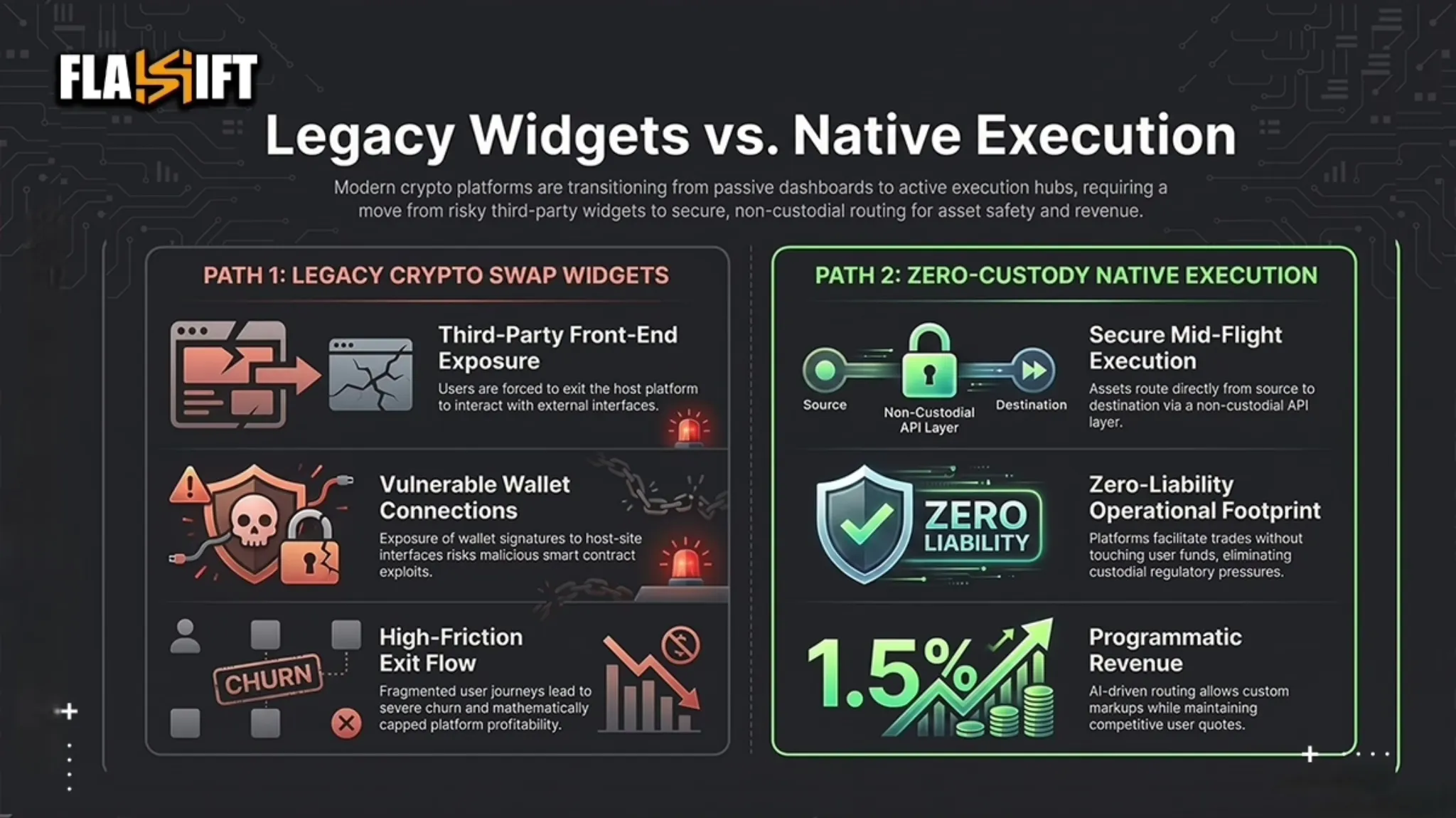
Integrating legacy crypto swap widgets presents a critical security flaw that alienates advanced traders: they force users to sign Web3 wallet connections directly on third-party front-ends. For seasoned professionals, exposing wallet signatures to unknown, host-site interfaces is an unacceptable risk due to the prevalence of malicious approval exploits.
A resilient tracking platform must eliminate this friction entirely. By deploying a non-custodial exchange API architecture, platforms can bypass the dangerous requirement of direct wallet connections. Instead of acting as a vulnerable intermediary point for smart contracts, the host platform simply facilitates a secure, mid-flight execution path.
Assets are routed straight from the user’s source wallet to the execution provider, returning cleanly to their designated destination, ensuring the host site maintains a zero-liability operational footprint.
Embedding a Zero-Custody Routing Engine
The evolution of cross-chain interaction is defined by Chain Abstraction, making the underlying complexities of blockchain infrastructure entirely invisible to the end user. When a user wishes to rebalance a portfolio from Bitcoin to an Ethereum-native asset, they should not be burdened with bridging mechanics, wrapped assets, or multiple gas tokens.
Embedding a zero-custody routing engine solves this natively. Because the infrastructure is fundamentally wallet-agnostic, users maintain absolute financial sovereignty. As explored in our technical breakdown of cross-chain liquidity aggregation APIs, this architecture allows your platform to facilitate seamless transitions across isolated networks.
You provide the ultimate decentralized experience, instant execution across distinct ecosystems, while operating strictly as a technology layer, completely insulated from custodial regulatory pressures.
The Mathematics of Monetization: Custom Fees & Dynamic Slippage Mitigation
Monetizing your platform via an embedded execution layer transforms user retention directly into yield. When a non-custodial gateway is deployed, the tracking site earns a programmatic percentage of the transaction volume.
The underlying mathematics of this revenue depend on aggregation depth and execution intelligence. Relying on a single liquidity provider often results in static, uncompetitive base fees around 0.3%. However, by utilizing an AI-driven routing engine that dynamically scans 50+compliant providers globally, platforms can programmatically apply up to a 1.5% custom markup without degrading the final user quote.
The AI continuously evaluates post-trade metrics and real-time operational health, immediately isolating providers exhibiting high transaction failure rates or hidden KYC traps. This dynamic slippage mitigation ensures that your B2B monetization and routing API operates flawlessly, prioritizing successful, honest transactions over theoretical penny-saving that risks stuck assets.
Deployment and B2B Integration: Absolute Sovereignty, Maximum Retention
The transition from a passive data tracker to an active execution hub does not require rebuilding your backend infrastructure. Integrating Flashift’s routing engine allows your development team to embed enterprise-grade cross-chain capabilities natively into your UI.
Because the entire transaction lifecycle is strictly non-custodial, your platform never touches user funds, eliminating the burden of managing hot wallets, liquidity pools, or complex compliance frameworks.
You maintain the trust of your user base through absolute financial sovereignty while establishing a robust, automated revenue pipeline. The result is a frictionless, secure environment where users manage their wealth efficiently, and your platform capitalizes on every execution.