
In 2026, active operators in Tier-1 markets (US, UK, DE) are realizing a harsh reality: saving a fraction of a percent in trading fees is useless if your exchange arbitrarily freezes your account or leaks your passport data in a catastrophic hack.
The primary challenge for advanced investors today is executing trades at scale without surrendering their private keys and personal identity to centralized gatekeepers. The solution is no longer finding the “best” traditional exchange; it is adopting a Sovereign Execution strategy. By utilizing non-custodial routing aggregators, you can access the deepest global liquidity and execute cross-chain swaps directly from your hardware wallet—with zero accounts, zero KYC, and zero counterparty risk.
This comprehensive guide redefines the criteria for choosing an exchange in 2026, equipping you with the exact protocols needed to protect your capital.
📊 The 2026 Exchange Matrix: CEX vs. Sovereign Aggregators
To make an informed decision, you must immediately understand the structural differences between traditional centralized exchanges (CEXs) and modern sovereign aggregators (like Flashift). Here is how they compare across critical metrics:
| Evaluation Metric | Traditional CEX (Custodial) | Sovereign Aggregator (Flashift) |
| Asset Custody | 🔴 Exchange holds your private keys and funds. | 🟢 Hardware Self-Custody (You own your keys). |
| Identity Protection | 🔴 Mandatory KYC; targets for massive data breaches. | 🟢 Zero Data Collection (No accounts, No-KYC). |
| Market Access | Limited strictly to the liquidity on their internal order books. | 🟢 Aggregates liquidity from dozens of decentralized pools. |
| Execution Security | High risk of algorithmic withdrawal freezes during market crashes. | 🟢 AI-monitored execution without vulnerable cross-chain bridges. |
The Custodial Trap: Why Traditional CEXs Fail Advanced Investors
Before evaluating specific features, it is vital to understand why the traditional centralized exchange model is fundamentally flawed for anyone seeking financial sovereignty.
When you deposit funds into a centralized exchange, you are no longer holding cryptocurrency; you are holding a digital IOU from a corporation. These platforms act as massive custodial honeypots. They force users to undergo invasive Know Your Customer (KYC) procedures, permanently linking your real-world identity to your public blockchain footprint.
Furthermore, during periods of extreme market volatility, exactly when you need to execute a trade or secure your profits, centralized exchanges are notorious for experiencing “technical difficulties” or triggering algorithmic account freezes. To truly secure your investments, your primary criterion for an exchange must be the absolute elimination of counterparty risk.
⚡ The 5 Critical Pillars for Choosing an Exchange
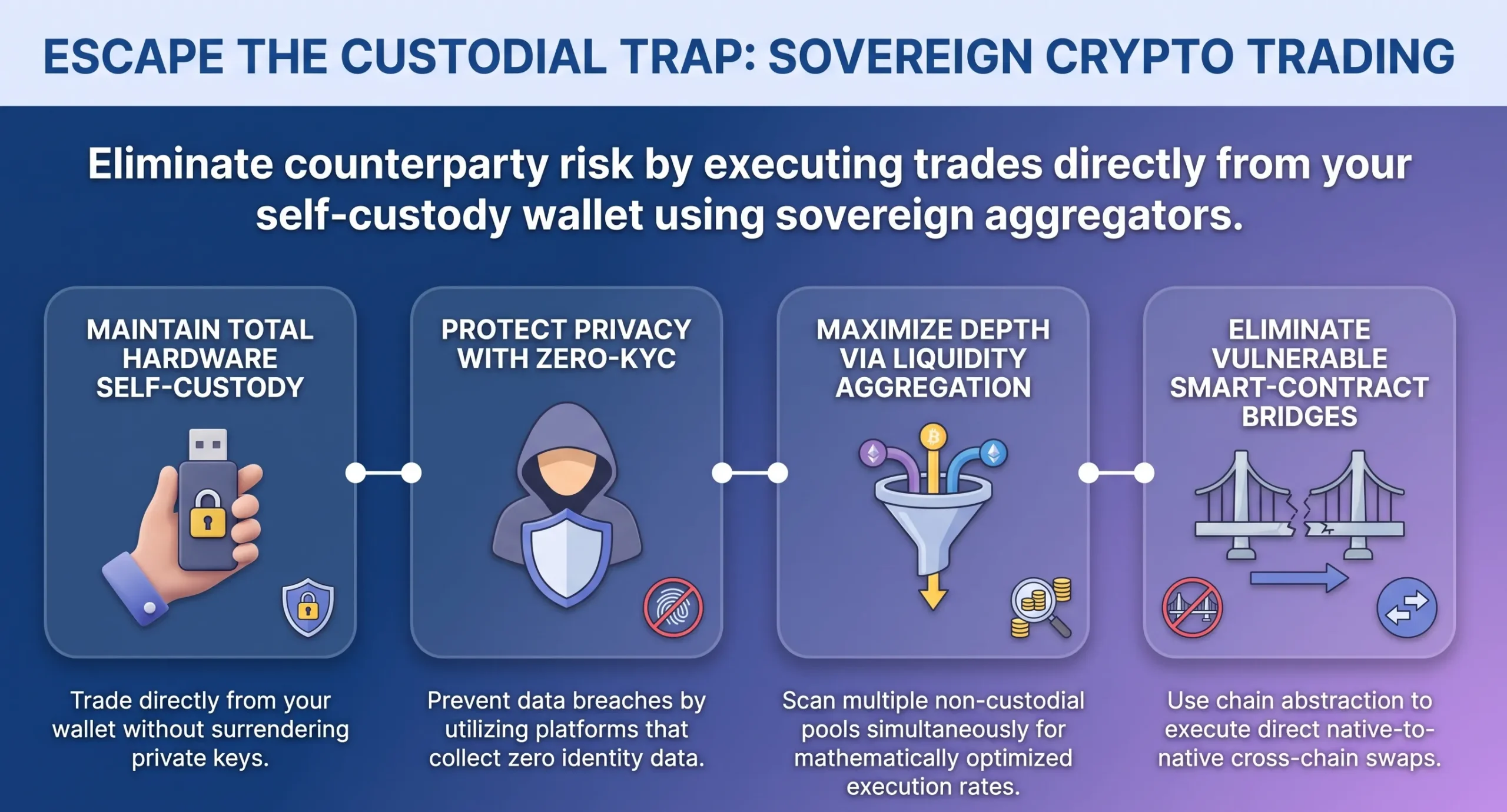
To maintain financial sovereignty and execute trades seamlessly, demand the following structural features from your chosen exchange infrastructure:
1. Custody and Private Keys (The Ultimate Security Test)
The golden rule of cryptocurrency remains absolute: “Not your keys, not your coins.” The best exchange is one that never actually takes possession of your assets. You should exclusively utilize platforms that allow you to swap digital assets directly from your personal hardware wallet (like Ledger or Trezor) or software wallet via isolated, single-use deposit addresses. If a platform requires you to deposit funds into their internal wallets, you are exposed to platform insolvency.
2. Identity Protection and KYC Mandates
Financial privacy is a right, not a crime. Exchanges that mandate the collection of passports, driver’s licenses, and facial scans create massive, centralized databases of highly sensitive information. Historically, these databases are prime targets for cybercriminals. The most secure exchange infrastructure operates on a No-KYC basis, collecting zero data and allowing you to execute trades based solely on cryptographic signatures.
3. Liquidity Depth and Anti-Slippage Mechanisms
A common issue with decentralized trading is limited liquidity pools, which leads to high bid-ask spreads and hidden slippage (where the execution price is worse than the quoted price). Instead of relying on a single exchange’s order book, you should utilize an aggregator. Aggregators scan multiple premium liquidity providers in real-time, mathematically guaranteeing the best possible rate and maximum market depth for your specific trade.
4. Transparent Fee Structures vs. Hidden Costs
Traditional exchanges often advertise low trading fees (e.g., 0.1% maker/taker) but hide exorbitant network gas fees or arbitrary withdrawal costs. When evaluating a platform, demand absolute transparency. You need an environment where the quoted rate includes all necessary network fees, ensuring that the net amount you expect is exactly what lands in your wallet.
5. Cross-Chain Routing (Bridges vs. Native Swaps)
When trading assets across different blockchain networks, many decentralized platforms force users to rely on cross-chain bridges or mint wrapped synthetic tokens (like WBTC). These smart contracts possess massive vulnerabilities and account for billions of dollars in industry hacks. The most secure platforms operate as a Chain Abstraction Layer, executing direct native-to-native swaps so you receive the authentic asset without ever being exposed to bridge exploits.
AI-Driven Execution: The New Standard in Crypto Security
In the highly fragmented decentralized market, some third-party liquidity providers employ predatory tactics. For example, they might display a highly competitive rate to attract your capital, only to apply hidden slippage or suddenly pause the transaction to demand KYC documentation after your deposit is made (a classic bait-and-switch).
Elite routing platforms mitigate this through advanced Artificial Intelligence. Flashift, for instance, deploys Continuous Post-Trade Analysis. This AI-driven security protocol actively monitors your execution path in real-time. If a liquidity provider attempts any predatory tactic, the AI instantly detects the anomaly, blacklists the malicious provider, and secures your funds, guaranteeing flawless execution.
How to Execute Sovereign Swaps with Zero-Approval (Step-by-Step)
Flashift represents the apex of cryptocurrency execution in 2026. As a pure Chain Abstraction Layer, Flashift aggregates the best market rates from premium non-custodial liquidity providers without ever compromising your identity or taking custody of your funds.
Execute Your Strategy Today:
-
Select your desired input and output assets.
-
Provide your destination wallet address.
-
Send the funds from your self-custody wallet to the provided single-use address.
-
Receive your swapped native assets directly into your wallet.
Secure Your Financial Sovereignty: Stop exposing your data and capital to centralized gatekeepers. Instantly swap your digital assets at the best rates using our No-KYC, zero-approval routing engine.
The Importance of 24/7 Human Oversight in Decentralized Markets
While AI and automated smart contracts provide incredible speed and efficiency, the reality of global blockchains is that networks occasionally experience severe congestion, forks, or node disruptions. The best cryptocurrency execution platforms back up their automated routing with a dedicated, 24/7 human operational support desk. Active human oversight ensures that if a cross-chain settlement is delayed by a network anomaly, specialists are immediately available to intervene and guarantee the safe delivery or return of your capital.
❓ FAQ
Why should I avoid leaving my cryptocurrency on a centralized exchange?
Leaving assets on a centralized exchange (CEX) means you do not control the private keys. The exchange can legally freeze your account, halt withdrawals during market crashes, or fall victim to insolvency. Additionally, centralized exchanges are prime targets for hackers seeking both cryptocurrency and sensitive user identity data.
What does it mean for an exchange to be “non-custodial”?
A non-custodial exchange or aggregator does not hold your funds. Instead of depositing money into the platform’s internal wallet, your assets are routed directly from your personal wallet, swapped through a liquidity pool, and sent directly to your destination address. You maintain total control of your private keys at all times.
How do trading fees impact overall costs on traditional exchanges?
Traditional exchanges often lure users with low maker/taker fees but offset this by charging high, hidden withdrawal fees or inflating the bid-ask spread. This significantly reduces your net trading profit. It is crucial to use platforms that offer transparent, all-inclusive pricing.
How do I find the best liquidity and lowest fees without using a CEX?
You should use a liquidity aggregator like Flashift. Instead of relying on a single exchange’s order book, an aggregator scans multiple decentralized and non-custodial platforms simultaneously to secure the deepest market depth and best available rate for your trade.
What is the safest way to swap crypto without KYC?
The safest method is utilizing a non-custodial routing aggregator. Because these platforms do not hold your funds or act as custodial financial institutions, there is no requirement to create an account, provide passwords, or submit KYC identity documents.
What is the danger of cross-chain bridges in crypto exchanges?
Traditional cross-chain bridges require locking your original assets in a smart contract to mint a “wrapped” version on the new blockchain. These bridge contracts contain massive vulnerabilities and are frequently drained by hackers. Utilizing a Chain Abstraction Layer that offers native-to-native swaps is significantly safe