
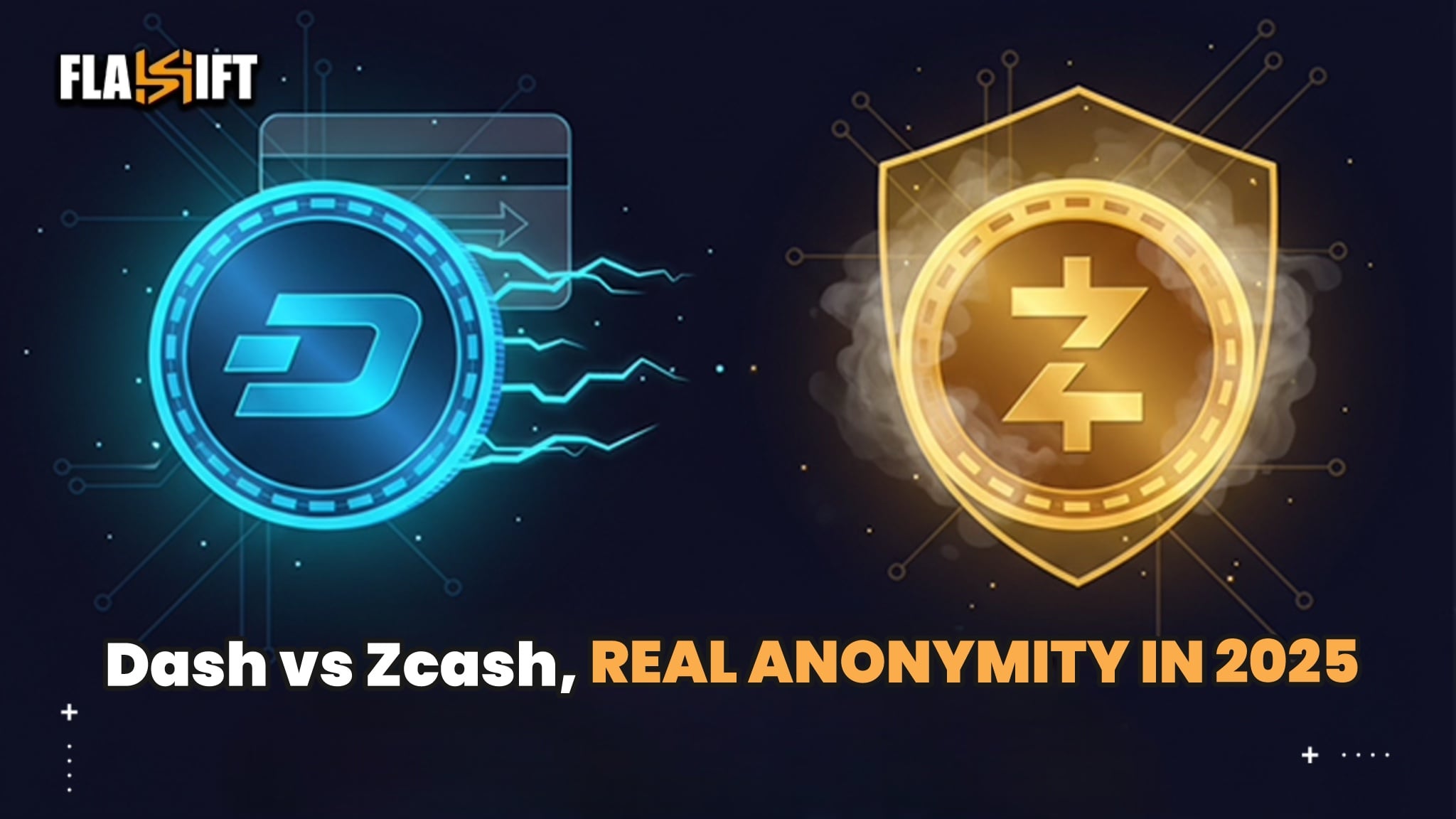
Dash vs Zcash | In a digital world, privacy is no longer just a motto, it’s a strategic edge. You’ve just wrapped your week’s freelance projects, your client pays in crypto — but you don’t want your payment sitting on a centralized exchange. You need speed, privacy, and control. That’s where the crossroads appear: DASH and ZCASH, each representing a different philosophy of financial freedom.
In this cast, we compare Dash (DASH) and Zcash (ZEC) through the lenses that matter:
real-world use, tech under the hood, cost, speed, adoption and privacy-depth.
And this is where Flashift comes in, the bridge that gives you both privacy and power, non‑custodially.

Overview of Dash vs Zcash
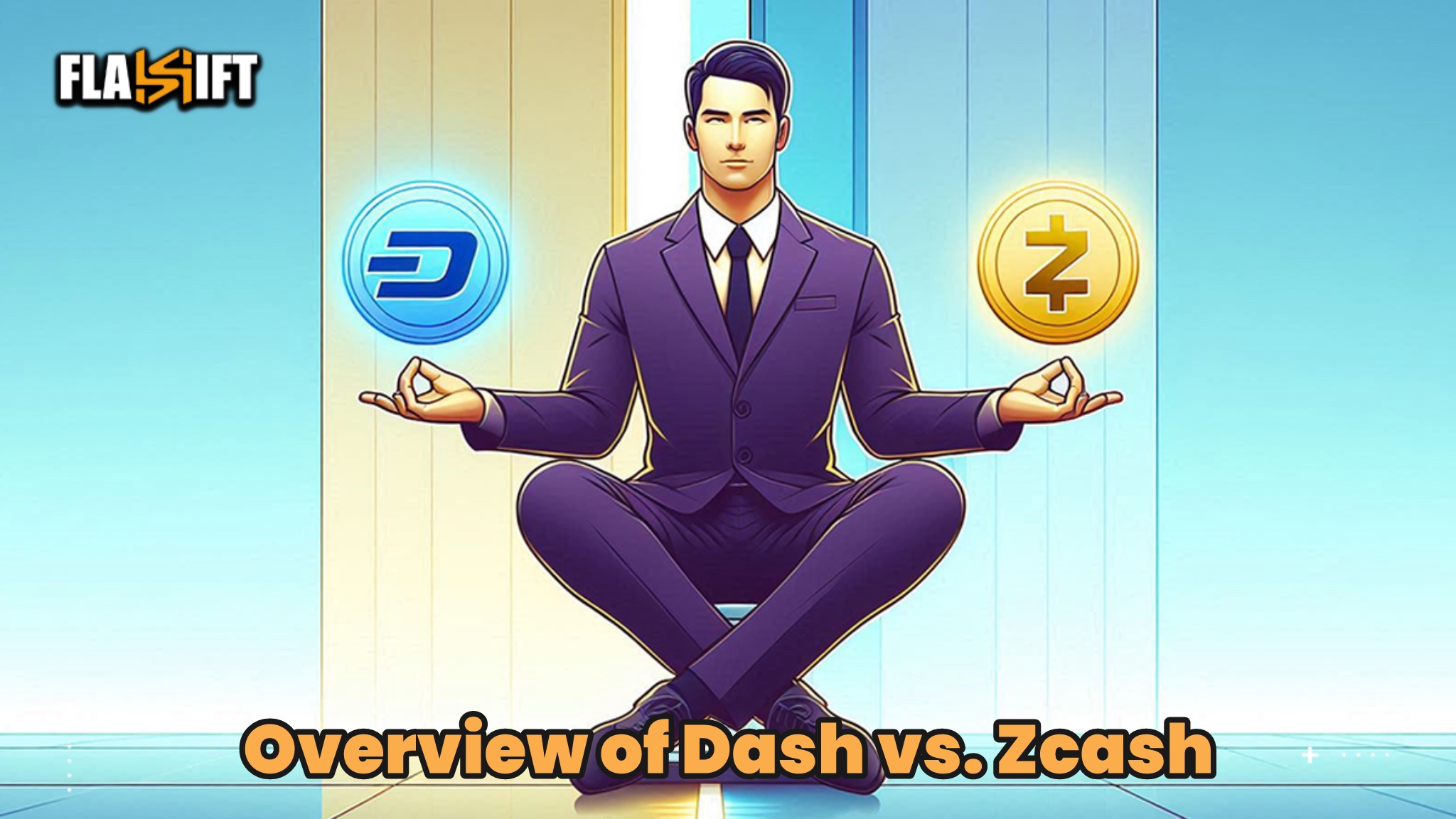
Both coins sit in the “privacy” category, but they’re playing very different games. Understanding their roots, their evolving narratives and their standing in 2025 is your first step toward choosing the right tool.
Dash’s payment-first vs Zcash’s privacy-first
Launched in 2014 as “Digital Cash,” Dash was built for frictionless daily spending: near‑instant confirmation, micro‑fees, and merchant integration long before mainstream crypto talked about usability. Its InstantSend and ChainLocks made 2.5‑minute block times feel like seconds.
Read More: How to Swap Dash (DASH) Without KYC in 2025
When Zcash emerged in 2016, it redefined privacy. Built on the science of zero‑knowledge proofs, Zcash enabled something revolutionary — the ability to prove a transaction happened without revealing any data at all. Its zk‑SNARK system remains one of the purest implementations of on‑chain secrecy.
These two coins represent these philosophies:
- Dash: fast, usable, transparent — with optional privacy.
- Zcash: deeply private — with optional transparency.
Read More: How to Swap Zcash (ZEC) Without KYC in 2025
Market metrics in 2025
ZEC is capped at 21 million and carries a strong “privacy tech” narrative, but only ~20 % of its coins are in shielded mode (July 2025). Dash’s ecosystem is more built out for payments and merchant flows, with high liquidity and real-use cases.
Use-cases and narrative shift
Dash markets itself as a fast, utility coin with optional privacy for everyday use; Zcash emphasises selectable transparency vs shielded privacy for users who demand stronger anonymity. In 2025 the narrative for both is shifting toward privacy, but with different strategic angles
Read More: Privacy Coins Explained: How Monero, Zcash, and Dash Safeguard Your Financial Privacy
Transaction Privacy Models
You can’t talk about “real anonymity” without understanding how the privacy is implemented. Dash uses mixing; Zcash uses zk-SNARKs. But real-world effectiveness depends on user behaviour, adoption, ecosystem.
Dash’s PrivateSend
Dash offers PrivateSend (a CoinJoin‑based system) that blends multiple transactions into one, obscuring traceability while remaining compatible with regulators. Upgrades in Dash Core v20 placed privacy settings directly in the wallet UX.
Dash balances pragmatism and choice: users can stay transparent for business needs or mix funds when discretion is essential. Recent data from the Dash platform indicates a 25 % year‑over‑year increase in PrivateSend usage, coinciding with freelancer migration toward crypto payments under tight banking oversight.
Zcash’s transactions
Zcash transactions can be fully shielded (“z‑addresses”) or transparent (“t‑addresses”). The 2025 rollout of Unified Addresses (UAs) has solved the biggest friction barrier—users no longer have to choose. Every transaction route is invisibly optimized.
Zcash now runs proof aggregation that cuts transaction sizes by 40 %, enabling faster confirmations and lower gas (especially on mobile wallets). Privacy isn’t a toggle in ZEC—it’s the default standard.

Practical anonymity analysis
For Zcash, while the tech is top-tier, only a fraction of users use shielded mode, this reduces the effective anonymity set and opens heuristics. For Dash, even when mixing is available the fact that many users don’t mix, or mix small amounts, limits real privacy. Use isn’t just capability—it’s behaviour.
Table of Privacy Model Comparison Dash vs. Zcash
| Feature | Dash (PrivateSend) | Zcash (Shielded mode) |
| Privacy default | Transparent unless mixing enabled | Transparent by default; shielded if you activate z-addrs |
| Model | CoinJoin/masternode mixing | zk-SNARKs zero-knowledge proofs |
| Amount hiding | No (only mixing obscures sources) | Yes — amounts, senders, receivers can be hidden |
| Complexity / UX | Simpler, but optional and less usage | Stronger tech, but requires using shielded addresses |
| Empirical anonymity limits | Depends highly on usage pattern | Shielded pool size and heuristics reduce anonymity if under-used |
Read More: Zano (ZANO), The Overlooked Privacy Coin You Should Know in 2025
Speed, Fees & Adoption
It doesn’t matter how private a coin could be if you can’t use it efficiently, affordably, or find liquidity. For users making a real decision in 2025, usability matters as much as tech.
Dash vs Zcash real-world numbers
Dash boasts very fast confirmations (block time ~2.5 minutes) thanks to InstantSend and ChainLocks. Zcash, while improving, still has heavier proofs for shielded mode which can mean slower wallet syncing or longer wait times for deeper privacy.

Fee structures and cost of privacy
When you mix on Dash: you pay for network fee + mixing overhead (but modest). On Zcash: shielded mode can increase fees or latency, and leaving funds transparent reduces privacy drastically.
Adoption signals in 2025
Privacy coins are under regulatory pressure. Zcash’s strong tech doesn’t automatically mean mass merchant adoption; Dash’s payment-oriented model gives it real-world use. According to current market signals, both have momentum but different user-profiles.
| Metric | Dash (DASH) | Zcash (ZEC) | Bitcoin (BTC) for ref |
|---|---|---|---|
| Avg. Fee (USD equivalent) | 0.0023 | 0.0041 | 2.13 |
| Confirm time | 1.5 s | 2.8 s | 10 min + |
| Energy Efficiency | Masternode (PoW/PoS Hybrid) | PoW Blossom + ZK Lightproofs | Pure PoW |
| Privacy intensity | Medium (Optional) | High (Default Shielded) | Low |
Read More: Best Privacy Coins 2025: Dash, Railgun, and Zano | The Next Generation of Privacy Coins
Future Outlook
As we move through 2025 and beyond, upgrades, regulation and user behaviour will shape which coin truly delivers anonymous crypto. You want a coin that doesn’t just promise privacy—but actively supports it, and is usable in your country under evolving regulation.
Roadmaps and upgrades
Zcash continues to refine its shielded pool with more efficient zk-proofs and mobile-friendly wallet support. Dash is exploring Confidential Transactions (CT) and improvements to its privacy stack while maintaining merchant usability.
how privacy coins are viewed in the regulatory landscape
Both coins face scrutiny: exchanges delist privacy coins, jurisdictions debate AML/KYC laws. The coin that balances privacy capability + regulatory resiliency wins. Flashift’s swap path takes this into account, offering a compliant but user-centric approach.
which coin might serve your needs (payment vs privacy vs hybrid)
If you are a U.S. single user seeking fast transactions plus optional privacy and you plan to use the coin in real-world flows—Dash may feel more comfortable. If you are privacy-first, willing to take slightly more complexity and cost for deep anonymity—Zcash may be the better pick. But if you plan to swap and be in control, here’s where Flashift excels.

Why Flashift is Your Swap Destination
Here’s why, after reading this comparison, you’ll want to use Flashift to act on your choice:
- No registration, no forms: Maintain control and anonymity.
- Speed: Swap quickly, whether you choose Dash or Zcash.
- Privacy-first design: Non-custodial wallet-to-wallet flow means you stay in charge.
- Optimal fees: Competitive rates for users.
- Support for your coin choice: Swap Dash or Zcash and other assets, all in one place.
When your goal is action—not just reading—Flashift gives the bridge between your decision and execution. After comparing Dash vs Zcash, you are now ready to move. And you know that the wise choice is to move with Flashift.
FAQs
Which coin offers stronger anonymity—Dash or Zcash?
Zcash’s shielded mode uses more advanced cryptographic privacy (zk-SNARKs) and hides more transaction data if used properly. But in practice, because many users transact via transparent addresses, the anonymity set is smaller. Dash offers simpler optional mixing and faster use—but actual anonymity depends on user behaviour and whether mixing is used.
Can I achieve real anonymous crypto swap using Dash on Flashift?
Yes. By choosing Dash, using its mixing features if desired, and swapping via Flashift’s wallet-to-wallet non-custodial flow, you retain control of your identity, remain private and execute quickly.
Does using Zcash guarantee totally anonymous transactions?
Not automatically. While Zcash has technically strong privacy tools, you must use the shielded addresses (z-addrs) and avoid re-using transparent flows. Academic research shows patterns can still leak identity unless best practices are followed.
Is Dash faster and cheaper to use right now for U.S./Canada users?
Generally yes. Dash offers faster real-world confirmations and lower fees for standard transfers. If you prioritise speed + optional privacy, Dash is often more user-friendly.
How do I decide between Dash and Zcash for my goals?
Ask yourself:
Do I prioritise merchant usage, speed and liquidity? Then Dash.
Do I prioritise strong anonymity and am comfortable with more complexity? Then Zcash.
Either way, if you’re ready to swap, Flashift is the platform that lets you convert with minimal friction, no forms, and delivered control.