
- Professional Execution Standards Comparison
- 📈 Understanding the 2026 Privacy Tokens Market Rotation Cross-Chain Infrastructure
- 🛡️ Finding the Best Cross Chain Privacy Routers for Prop Traders
- ⚙️ Automated Post Trade Analysis Liquidity Aggregation: Preventing Bait and Switch Slippage on Chain Swaps
- 🔒 Post Deposit KYC Hold Crypto Exchange Solutions
- 📁 How to Swap Zcash Shielded Addresses Non Custodial via Zashi Wallet Cross Chain Swap Routing
- 🤝 How to Exchange Dash Privately Without Centralized KYC
- ⚠️ Railgun zk Snark Transaction Failure Rates and Mitigating Non Custodial Zero Knowledge Smart Contract Exploits
- 🎯 Conclusion: Securing Financial Sovereignty in 2026
- 💡 FAQs
You’ve spent weeks executing highly profitable strategies, only to have your entire balance frozen by a centralized custodian because of an automated, false-positive compliance flag. 🚫 In the hyper-surveilled market of 2026, the greatest risk to your portfolio isn’t a bad trade—it is the complete lack of transaction privacy that exposes your capital footprint to front-runners, MEV bots, and predatory exchange freezes.
If you are still routing large-volume transfers through fully transparent public ledgers, you are effectively trading with your cards face up on the table. Before executing your next high-volume rebalance, you should protect your capital footprint and route your swap instantly to keep your trading strategies completely confidential. 🛡️
Professional Execution Standards Comparison
| Operational Metric | Transparent Public Chains (e.g., ETH, SOL) | Shielded Privacy Networks (ZEC, DASH, RAIL) | Flashift AI-Routed Ecosystem |
|---|---|---|---|
| Transaction Visibility | 100% Public (Exploitable by MEV Bots) | Cryptographically Hidden (Shielded) | Pure Wallet-to-Wallet Routing Layer |
| Slippage Risk | High (Target for Front-Running) | Medium (Fragmented Pools) | Zero (Automated Slippage Mitigation) |
| KYC Vulnerability | Constant (Centralized Custodian Bottlenecks) | Dependent on Wallet/Exchange Choice | Active Filter Against Predatory Holds |
| Execution Speed | Network Dependent (15 – 5 m) | Variable (High Shielding Latency) | Instant (Under 3 minutes) |
📈 Understanding the 2026 Privacy Tokens Market Rotation Cross-Chain Infrastructure
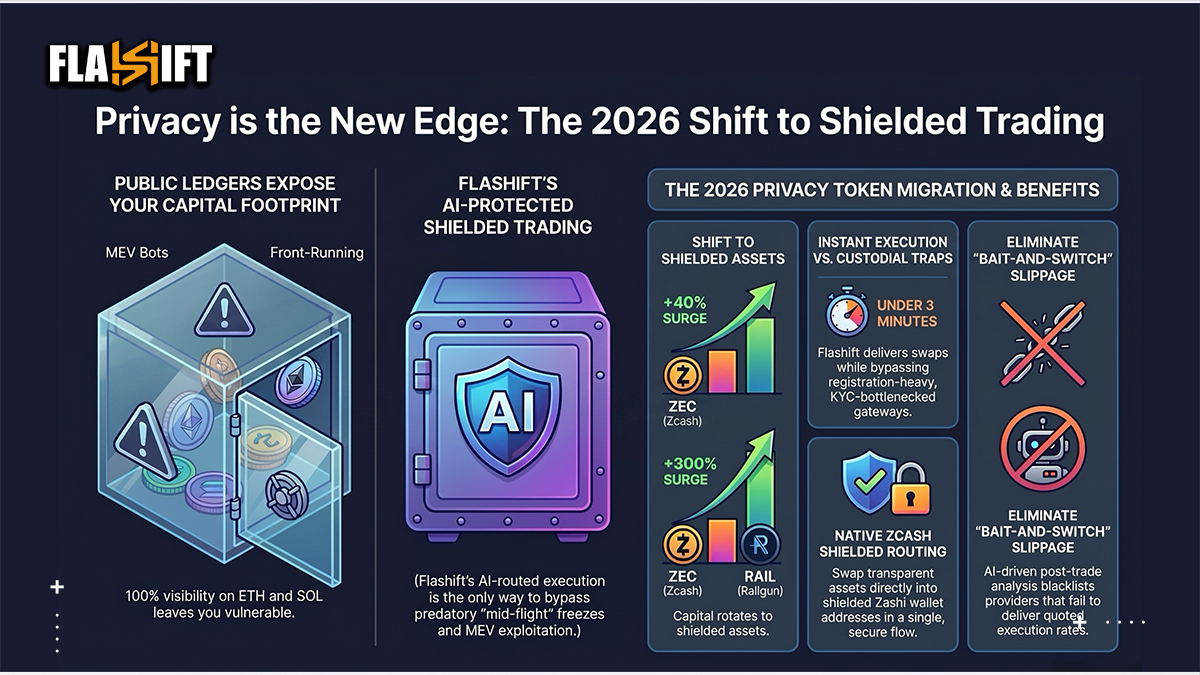
The massive volume flowing into alternative assets isn’t random speculative noise; it is a calculated migration. During recent market expansions, Zcash (ZEC) surged over 40% in a single 24-hour window, reclaiming spot execution baselines above 230 with over 1.1 billion in aggregate daily volume. Simultaneously, Railgun (RAIL) logged weekly gains exceeding 300%, heavily driven by its integration into developer-focused zero-knowledge toolkits. 📈
This capital movement represents a larger structural trend. As mainstream DeFi ecosystems become increasingly saturated with surveillance tools, understanding the current privacy tokens market rotation cross-chain infrastructure becomes vital for protecting your edge. When major capital allocators rotate their positions, they require specialized routing paths to execute these private transfers without returning to centralized, KYC-heavy custodial gateways.
To stay ahead of this paradigm shift, smart money is increasingly choosing to execute non-custodial cross-chain swaps that completely avoid intermediate custody. ⛓️
🛡️ Finding the Best Cross Chain Privacy Routers for Prop Traders
For professional market actors, finding a cheap rate on an aggregator screen is useless if the transaction gets stuck in a compliance trap. Centralized exchange pools frequently permit large-volume deposits without registration, only to trigger a lock the moment your capital lands in their hot wallet. This vulnerability has forced serious market participants to thoroughly evaluate the best cross chain privacy routers for prop traders before moving funded account profits. 🛡️
By avoiding platforms that require persistent web3 permissions or account logins, traders can interact with the multi-chain ecosystem on a strictly transactional basis. Eliminating the platform login wall means your transaction history cannot be linked to a single, targetable profile, shielding your trading strategies from institutional and proprietary front-running.
⚙️ Automated Post Trade Analysis Liquidity Aggregation: Preventing Bait and Switch Slippage on Chain Swaps
Traditional instant swap aggregators often function as passive rate-scrapers. They pull numbers from public APIs without verifying whether the underlying liquidity provider actually delivers that price. Flashift fundamentally reorganizes this model by utilizing automated post trade analysis liquidity aggregation to actively monitor the behavior of every connected partner. ⚙️
Rather than relying on static rate scraping, our dynamic routing engine performs continuous audits:
- 📊 It tracks the exact delta between the quoted rate at step one and the final asset volume deposited in the destination wallet.
- 🛡️ If the system detects a liquidity provider attempting to manipulate spreads or deliver poor execution rates, it instantly isolates that path to prevent bait and switch slippage on chain swaps.
- ⚡ This protection is automated and operates in the background, ensuring your large-volume rebalances are executed exactly as advertised.
If you value execution precision, you can check real-time routing rates on Flashift to see how our automated slippage protection optimizes your yield.
🔒 Post Deposit KYC Hold Crypto Exchange Solutions
The single greatest threat to professional capital movement is the sudden “mid-flight” freeze. Under the guise of unexpected compliance flags, centralized exchanges routinely allow deposits to clear in a privacy-preserving manner, only to hold the funds indefinitely when you attempt to withdraw or complete the swap. 🔒
Flashift addresses this vulnerability through automated post deposit kyc hold crypto exchange solutions. Our AI monitoring engine tracks transaction success rates and localized processing delays across all connected providers. If a liquidity provider shows an abnormal spike in compliance flags or mid-flight holding requests, Flashift instantly cuts traffic to that node, protecting your swap from sudden, predatory freezes.
📁 How to Swap Zcash Shielded Addresses Non Custodial via Zashi Wallet Cross Chain Swap Routing
Zcash remains the industry standard for zero-knowledge transaction privacy. Unlike transparent blockchains, Zcash utilizes zk-SNARK proofs to fully encrypt sender, receiver, and transaction amounts. Currently, over 20% of the circulating ZEC supply is securely stored within shielded addresses. The deployment of the Zashi wallet has made on-chain privacy incredibly accessible by enforcing shielded transactions by default. 📁
However, to truly master how to swap zcash shielded addresses non custodial, you must route around traditional centralized platforms. Flashift supports zcash zashi wallet cross chain swap routing natively, allowing you to move from transparent assets directly into shielded ZEC addresses in a single, secure flow.
Instead of managing multiple gas tokens, you can swap transparent assets to shielded ZEC natively without leaving a centralized deposit trail.
🤝 How to Exchange Dash Privately Without Centralized KYC
Dash continues to dominate the private merchant payments sector through its decentralized master-node network. While other privacy assets face heavy regulatory delisting pressure, Dash’s bifurcated transaction structure offers excellent flexibility. By utilizing its coin-joining integration, Dash allows users to mix transactions directly on-chain without trusting third-party custodians. 🤝
Professional allocators looking for how to exchange dash privately without centralized kyc rely on Flashift’s direct wallet-to-wallet execution model. By routing your Dash swaps through our registration-free interface, you preserve your financial sovereignty and completely avoid custodial honeypots.
⚠️ Railgun zk Snark Transaction Failure Rates and Mitigating Non Custodial Zero Knowledge Smart Contract Exploits
Railgun functions as a specialized, smart-contract-based privacy layer deployed directly on Ethereum and leading Layer-2 networks. Instead of forcing users to move to an entirely new blockchain, Railgun allows you to hold, swap, and deploy assets into DeFi protocols privately using zero-knowledge proofs. ⚠️
However, interacting with complex smart contracts introduces distinct operational hurdles:
- 📉 Gas Optimization: To ensure smooth execution, Flashift’s AI constantly monitors railgun zk snark transaction failure rates across separate smart contracts, protecting users from failed gas fees.
- 🛡️ Vulnerability Filtering: Because legacy smart contracts are often targets for exploits, our routing layer heavily filters out pools that are historically vulnerable to non custodial zero knowledge smart contract exploits, ensuring your capital remains 100% secure from start to finish.
🎯 Conclusion: Securing Financial Sovereignty in 2026
In the modern digital asset landscape, operating without transactional privacy is a massive structural risk. Protecting your portfolio footprint requires more than just holding your own private keys—it demands an intelligent, non-custodial routing infrastructure that actively shields your transactions from front-runners, predatory slippage, and unexpected custodial freezes. 🎯
By leveraging Flashift’s AI-driven, registration-free aggregation layer, you can move capital across multiple blockchains with absolute confidence. Stop leaving your strategies vulnerable on transparent ledgers; take control of your financial sovereignty and experience secure cross-chain swapping on Flashift today.
💡 FAQs
1. Why is the market rotating back to privacy tokens like Zcash and Railgun?
As global regulatory monitoring intensifies, transparent blockchains no longer offer protection against MEV front-running, public balance tracking, and arbitrary account freezes. The current market rotation is driven by professional traders migrating to zero-knowledge networks to protect their proprietary strategy footprints and assert financial sovereignty.
2. How does Flashift prevent “bait-and-switch” slippage on high-volume swaps?
Unlike basic aggregators that only scrape surface-level prices, Flashift’s AI engine performs continuous, real-time post-trade audits. If a partner exchange advertises an attractive price but delivers significantly less volume at execution, our system instantly blacklists that provider and redirects your transaction to a highly reliable route.
3. What makes Flashift different from traditional decentralized bridges?
Traditional bridges force you to lock your assets in vulnerable smart contracts to mint wrapped tokens. Flashift uses a pure chain-abstraction layer, routing native assets directly from your source wallet to your destination wallet without utilizing risky intermediary contracts.
4. Can I swap Zcash shielded addresses on Flashift?
Yes. Flashift natively supports routing into shielded ZEC addresses. You can initiate a swap from any transparent asset and have the funds deposited directly into your shielded Zashi wallet without undergoing centralized verification.
5. How does the platform protect against unexpected KYC holds?
Our AI monitoring system tracks transaction success rates and localized processing delays across all connected providers. If a liquidity provider shows an abnormal spike in mid-flight compliance flags or holding requests, Flashift instantly cuts traffic to that node, protecting your swap from sudden, post-deposit freezes.