
Moving assets between blockchains used to be slow, risky, and confusing. Today, a cross-chain crypto swap makes it possible to move value from one network to another in minutes, without complex steps or technical knowledge.
If you want to Swap ETH to SOL, you’re essentially converting assets from the Ethereum network to the Solana ecosystem. These chains don’t natively communicate, which is why cross-chain solutions exist. They act as a bridge, handling the conversion behind the scenes while you receive SOL directly in your wallet.
The key advantage is speed and simplicity. Instead of using centralized exchanges, withdrawing, and waiting, a cross-chain crypto swap lets you convert ETH to SOL instantly, often in a single transaction flow.
In this guide, you’ll learn exactly how to do it safely, what to watch out for, and how to get the best rates when you swap Ethereum for Solana.
The Challenge of Cross-Chain Swaps (Ethereum to Solana)
Swapping assets between Ethereum and Solana is not a simple transfer. These are two completely different blockchains with separate architectures, rules, and ecosystems. They don’t natively “talk” to each other.
That’s where the challenge begins.
No Direct Compatibility
Ethereum uses an account-based model with ERC-20 tokens. Solana operates with a different token standard and high-speed architecture.
You can’t send ETH directly to a Solana wallet and expect it to arrive as SOL. Without an intermediary system, the transaction simply won’t work.
Reliance on Bridges or Intermediaries
To bridge ETH to SOL, a third layer is required (usually a bridge or an aggregator).
Traditional bridges lock your ETH on Ethereum and mint a wrapped version on another chain. This process introduces risk:
- Smart contract vulnerabilities
- Bridge hacks (a common target in crypto)
- Delays during network congestion
In many cases, users don’t realize they’re not getting native assets, but wrapped tokens.
Liquidity Fragmentation
Liquidity is not shared across chains.
The price of ETH on Ethereum and the value you receive as SOL on Solana depend on available liquidity across multiple platforms. Poor routing can lead to:
- Higher slippage
- Worse exchange rates
- Hidden fees
This is why two users swapping the same amount can get different results.
Complex User Experience
Manual cross-chain swaps often require multiple steps:
- Send ETH to an exchange or bridge
- Convert to another asset (like USDT or USDC)
- Withdraw to Solana
- Swap again to SOL
Each step adds time, cost, and room for error.
Security and Trust Concerns
Cross-chain activity expands the attack surface. Users must trust:
- The bridge protocol
- The smart contracts
- The platform handling the swap
A single weak point can lead to loss of funds.
The Bridge includes Wrapped Tokens or Native Tokens? What are the differences?
The main differences between native SOL assets and wrapped tokens in the context of cross-chain swaps involve their usability, origin, and associated risks:
- Usability and Functionality: Native SOL is the actual asset of the Solana ecosystem and is more practical for immediate use in trading, staking, or transferring within that network. In contrast, wrapped tokens are issued by some bridges and may have limited usability compared to the native version.
- Method of Creation: Wrapped tokens are typically created when a traditional bridge locks your original asset (such as ETH) on one blockchain and mints a representative “wrapped” version on the destination chain. Native SOL is usually delivered directly to the user’s wallet when using modern aggregators that handle the conversion behind the scenes.
- Security Risks: Obtaining wrapped tokens through bridges introduces specific vulnerabilities, including bridge hacks and smart contract flaws. Furthermore, many users may not realize they have received a wrapped token instead of a native asset until they attempt to use it.
- Network Compatibility: Because Ethereum and Solana have different architectures and token standards, they cannot “talk” to each other natively. While you cannot send ETH directly to a Solana wallet and receive SOL, a cross-chain swap provides a bridge or intermediary layer to facilitate the exchange for either native or wrapped assets.
Aggregators generally aim to provide native tokens because it simplifies the user experience by providing a direct, usable asset without the need for further manual conversions
Swap ETH to SOL in 3 Minutes: No Accounts, No KYC
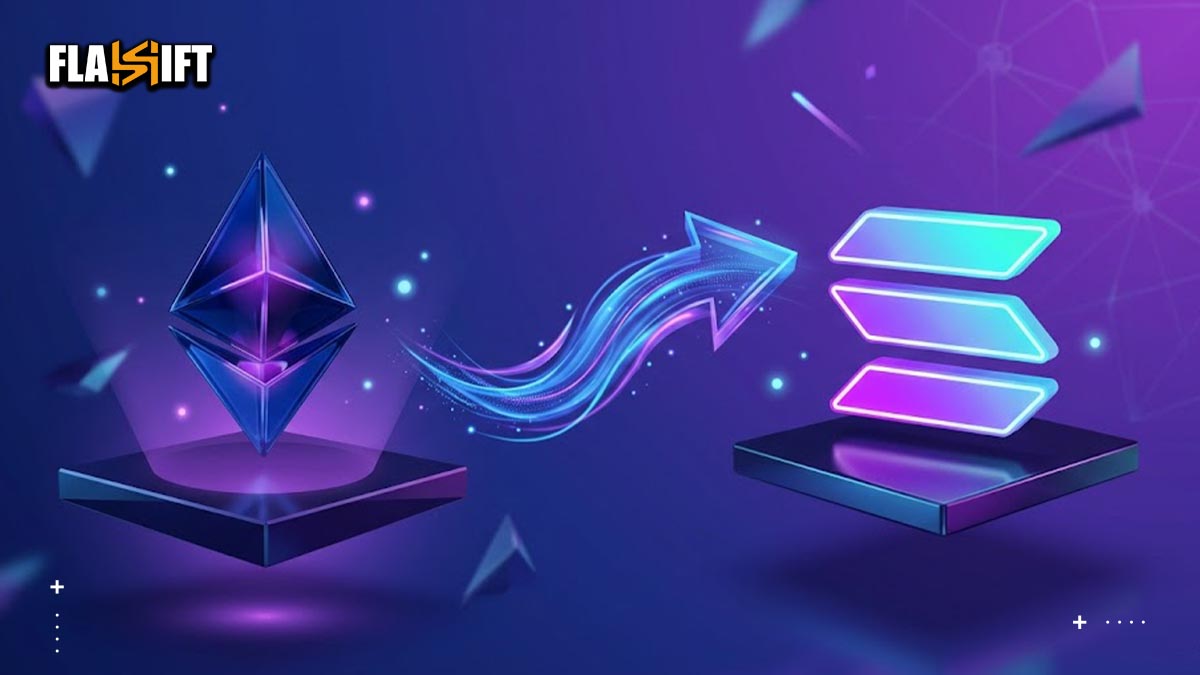
If you want to Swap ETH to SOL without delays, registrations, or identity checks, using a cross-chain aggregator like Flashift, changes the process completely.
Instead of dealing with bridges or multiple platforms, everything happens in one flow.
How It Works (Simple Flow)
Flashift connects to multiple exchanges and liquidity sources at once.
When you start a cross-chain crypto swap, it automatically finds the best route for your ETH and converts it into SOL on your behalf.
You don’t see the complexity. You just send and receive.
Typical process:
- Enter the amount of ETH you want to swap
- Paste your Solana wallet address
- Send ETH to the provided address
- Receive SOL directly in your wallet
No intermediate steps. No manual conversions.
Why It Feels Instant
The “3-minute” experience comes from parallel processing.
Flashift doesn’t rely on a single provider. It scans multiple options in real time and executes the fastest path. This reduces:
- Waiting time between transactions
- Price fluctuations during the swap
- Network-related delays
In most cases, your SOL arrives shortly after your ETH is confirmed.
No Accounts, No KYC
One of the biggest advantages is privacy.
You don’t need to:
- Create an account
- Submit documents
- Go through verification
This makes it ideal for users in restricted regions or anyone who prefers to keep their activity minimal and direct.
Better Rates Through Smart Routing
Rates can vary widely across platforms.
Flashift’s routing engine compares multiple exchanges and selects the most efficient path. This often results in:
- Lower slippage
- More competitive conversion rates
- Fewer hidden fees
You’re not locked into a single provider.
Built for Simplicity, Backed by Infrastructure
While the interface is simple, the backend handles the complexity of a cross-chain crypto swap; from liquidity sourcing to execution.
For users, it turns a complicated process into a single action:
send ETH, receive SOL.
The Takeaway
If you are going to Swap ETH to SOL quickly and without friction, Flashift offers a direct path.
No accounts. No KYC. Just a fast, streamlined cross-chain conversion.
Flashift’s Smart Routing for the ETH/SOL Pair
Most users think swapping is just about clicking “convert.” In reality, the path your trade takes determines how much SOL you end up with, and how long it takes to get there.
With Flashift, that path isn’t fixed. It’s calculated in real time.
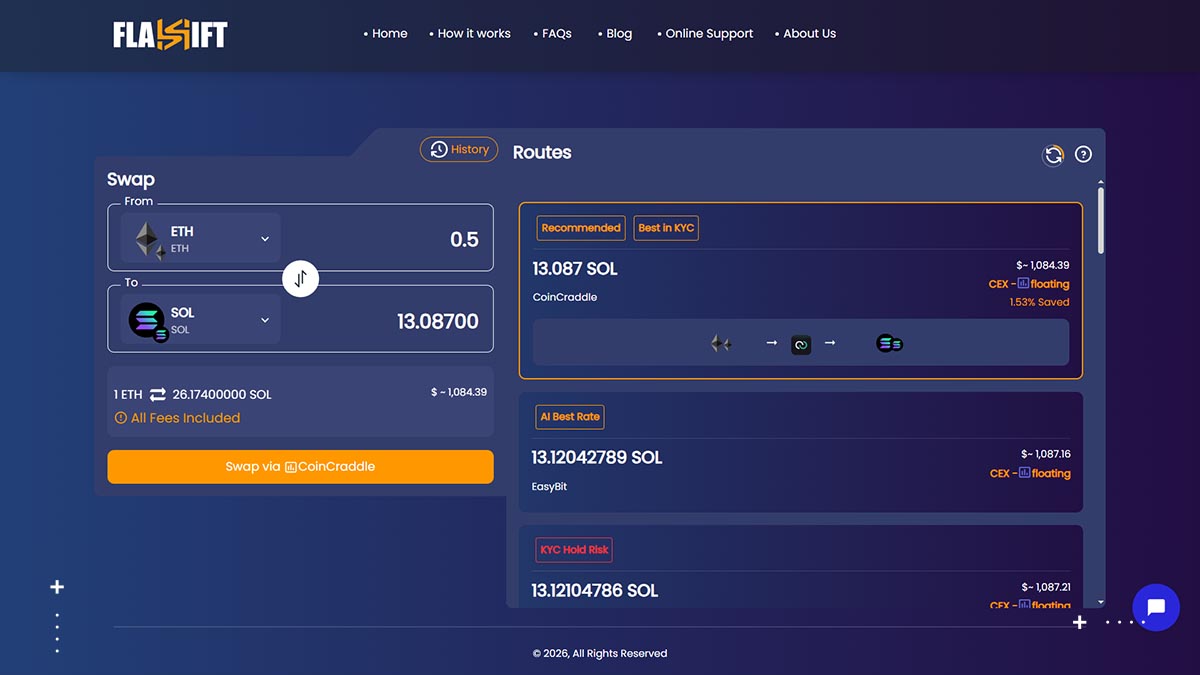
A Dynamic Route, Not a Fixed One
There’s no single market where ETH instantly becomes SOL. Behind every swap, there are usually multiple conversions happening across different platforms.
Flashift maps these possibilities on the fly. It checks multiple exchanges, compares routes, and builds the most efficient sequence for that exact moment.
So instead of forcing your trade through one provider, it adapts based on current conditions.
Why This Matters for swap ETH for SOL
This pair is naturally fragmented. Liquidity is spread across chains and platforms, and pricing can shift quickly. A basic route might work but it’s rarely the best one.
Flashift looks deeper:
- Which path minimizes total cost (not just visible fees)
- Where liquidity is strongest right now
- Which route avoids unnecessary conversions
The result is a cleaner, more efficient execution without you having to think about the mechanics.
Timing Plays a Bigger Role Than You Think
Crypto prices move fast, especially across chains.
Flashift’s routing engine reacts in real time. It doesn’t rely on outdated quotes or static pricing. Instead, it executes based on live data, reducing the chance of getting a worse deal mid-swap.
This is especially noticeable when markets are volatile.
Quietly Handling the Complexity
From the outside, it feels simple: enter ETH, receive SOL.
Under the hood, several decisions are being made in milliseconds—choosing routes, balancing speed vs. price, and avoiding weak liquidity pockets.
You’re not asked to manage any of it.
What You Actually Gain
Using smart routing here isn’t about adding features, it’s about removing inefficiencies.
- More consistent outcomes
- Fewer surprises in final amounts
- Less dependency on a single exchange
When you Swap ETH to SOL, that difference becomes clear in both speed and results.
Conclusion
Swapping between blockchains no longer needs to feel complicated or risky. What used to involve multiple platforms, manual conversions, and long waiting times can now be done in a single, streamlined process.
If your goal is to Swap ETH for SOL, the key is choosing a method that handles the complexity for you; without sacrificing speed, pricing, or control over your funds.
With solutions like Flashift, a cross-chain crypto swap becomes straightforward. You skip the accounts, avoid unnecessary steps, and get direct access to optimized routes across multiple exchanges.
In the end, it’s simple: fewer steps, better execution, and a faster way to move between Ethereum and Solana.
🚨 Cross-chain swaps involve smart contract risks. This is not financial advice. Always test with a small amount first.
FAQ
- Why do I sometimes receive slightly less SOL than the initial estimate?
Crypto prices can shift within seconds, especially across different chains. Even with smart routing, small changes in liquidity or network fees during execution can affect the final amount. Good aggregators aim to minimize this gap, but eliminating it entirely isn’t realistic.
- Is there a “best time” to Swap ETH to SOL?
Yes, timing can impact your outcome. Periods of low network congestion (especially on Ethereum) usually mean lower fees and faster confirmations. Also, avoiding high volatility moments can help you get more predictable rates.
- What happens if I send ETH but the swap fails midway?
In most cases, platforms like Flashift have fallback mechanisms. Depending on where the issue occurs, your funds are either refunded or the transaction is completed via an alternative route. Always double-check wallet addresses to avoid irreversible errors.
- Do I always receive native SOL, or can it be a wrapped version?
This depends on the method used. Some bridges issue wrapped assets, which can limit usability. Aggregators typically aim to deliver native SOL directly, which is more practical for trading, staking, or transferring within the Solana ecosystem.
- Can I track my cross-chain swap in real time?
Yes, but not from a single explorer. Since the process involves multiple chains, you may need to track the Ethereum transaction first, then follow the final delivery on Solana. Some platforms simplify this with a unified tracking interface.
- Is swapping small amounts inefficient compared to large trades?
Smaller swaps can be more sensitive to fixed fees and minimum limits, which may reduce overall efficiency. Larger trades benefit more from optimized routing, but they can also face liquidity constraints. The key is finding a balance where fees and rates make sense for your trade size.