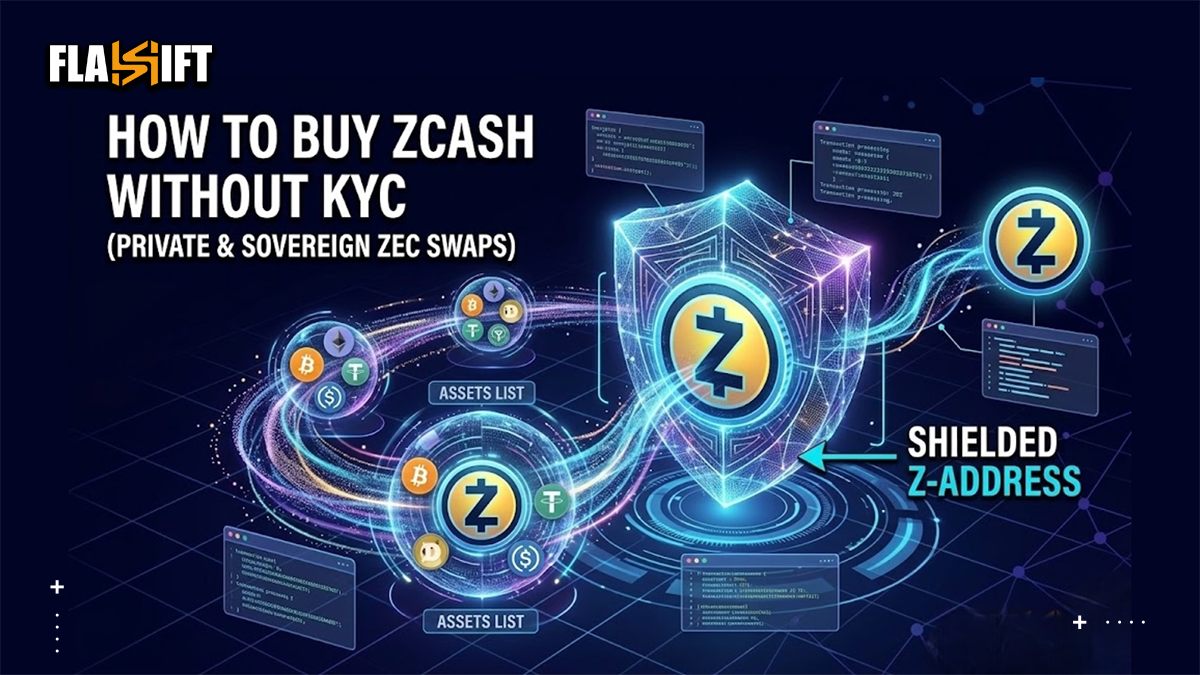
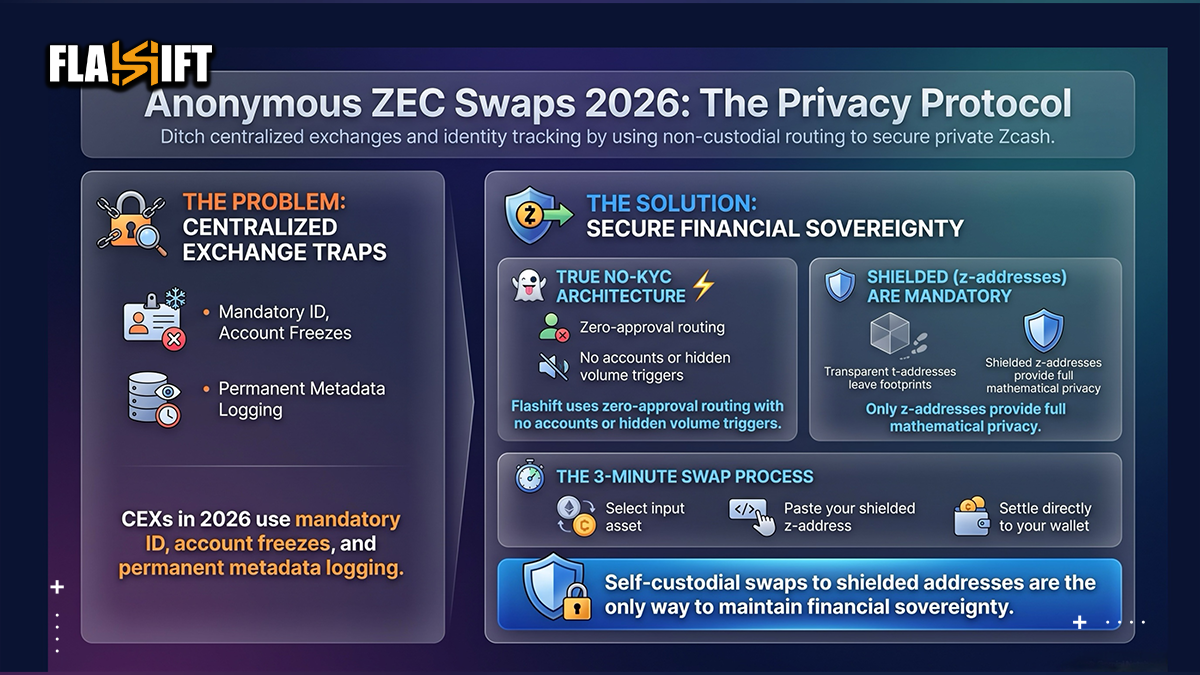
You hold USDT or BTC, and you need Zcash (ZEC) for true financial privacy. But in 2026, sending your transparent assets to a centralized exchange to buy ZEC is a trap. The moment you try to withdraw your new coins to a shielded z-address, algorithmic compliance engines will flag your account, demand intrusive KYC documents, or freeze your funds entirely.
You do not need to surrender your identity to acquire privacy. The safest way to buy Zcash without KYC today is to bypass centralized gatekeepers completely and use a strictly non-custodial execution layer.
By utilizing a private routing terminal like Flashift, you can execute a direct, wallet-to-wallet swap. Instantly convert your transparent assets straight into shielded ZEC in under three minutes—with zero account registration, zero ID verification, and zero third-party custody risks.
📊 The 2026 Zcash Swap Matrix: True No-KYC vs. Partial-KYC
Many platforms advertise “no-KYC” features but deploy hidden verification triggers the moment you attempt to withdraw or reach an arbitrary volume threshold. When evaluating a no-KYC self-custodial Zcash exchange, you must demand an uncompromising Zero-Approval architecture.
| Feature | no-KYC self-custodial exchange | Traditional Swaps (e.g., SideShift) | Centralized Exchanges |
| Identity Verification | 🟢 Zero (No Accounts) | ⚠️ Triggered by Volume Algorithms | 🔴 Mandatory ID & Selfie |
| Z-Address (Shielded) | 🟢 Fully Supported | ⚠️ Spotty / Often Deprecated | 🔴 Banned / Delisted |
| Account Freezes | 🟢 Impossible (Non-Custodial) | ⚠️ High Risk (Custodial Traps) | 🔴 High Risk |
| Liquidity Sourcing | 🟢 Multi-DEX AI Aggregation | ⚠️ Single Liquidity Pool | 🔴 Internal Order Book |
🔍 Evaluating True Non-Custodial Swap Platforms
Not all “no-KYC” claims are equal. For a truly private experience, you need full ZEC support (including shielded addresses), ample liquidity, and zero verification queues. While platforms such as SideShift offer basic ZEC swaps, they often function with single liquidity pools and hidden algorithmic limits.
No-KYC self-custodial exchanges delivers a streamlined, multi-chain swap experience specifically designed for privacy-coin users. This means you benefit from minimal friction, broad chain coverage, and an interface built around securing your financial sovereignty, rather than treating privacy as an afterthought.
💰 Understanding Fees, Limits, and Privacy Tiers
Even in a non-custodial setup, executing a swap involves network fees and platform routing margins. The critical difference lies in how a platform manages your limits.
Some “private” platforms impose forced KYC when you cross specific volume thresholds (e.g., 10 BTC/day). Flashift emphasizes pure crypto-to-crypto execution and avoids forced KYC triggers, giving you clearer limits and zero surprises. Furthermore, your privacy tier depends entirely on the address you use: receiving ZEC into a transparent t-address leaves a visible on-chain footprint, which is why shielded execution is paramount.
A full guide: Zcash Bridge 2026: How to Bridge ZEC Across Chains (Step-by-Step Guide)
🛡️ Z-Address OpSec: Execute a ZEC Swap Step by Step
To maximize your mathematical privacy, never route funds to a transparent t-address if shielded liquidity is available. Zcash’s zero-knowledge proofs (zk-SNARKs) only fully protect your transaction graph when utilizing z-addresses.
Here is the strict operational protocol to swap to shielded Zcash securely:
- Generate a Shielded Wallet: Open a secure local wallet (like Ywallet or Zecwallet Lite) and generate a fresh z-address. Never reuse an address previously linked to a centralized platform.
- Initiate the Swap: Open a non-custodial swap platform (e.g: Flashift) . Select your input asset (e.g., USDT, BTC) and set ZEC as the output.
- Input Destination: Paste your shielded z-address. Flashift’s routing engine fully supports zero-knowledge destination addresses.
- Send & Settle: Deposit the exact input amount to the generated single-use address. Here Flashift AI executes the trade at the optimal aggregated rate and settles the ZEC directly to your shielded wallet in minutes.
⚡ Execute Your Swap Now: Stop risking your capital on custodial platforms. Use the Flashift terminal to convert your transparent assets into shielded ZEC instantly with zero IP logging.
🔒 Advanced Tips for Maintaining Financial Sovereignty
Maximizing safety requires operational discipline beyond just using a secure swap terminal. To maintain your privacy:
- Use Fresh Wallets: Avoid sending ZEC to or from addresses that have previously interacted with KYC-linked exchanges.
- Verify Non-Custodial Status: Ensure the platform you use never holds your private keys or requires account creation.
- Understand Regional Regulations: Swapping crypto-to-crypto without KYC is generally standard on-chain protocol, but converting that ZEC back into fiat (USD/EUR) via local off-ramps usually triggers identity requirements. Keep your operations strictly on-chain to maintain sovereignty.
❓ FAQ
- Is it legal to buy Zcash without KYC in 2026?
Yes. In most jurisdictions, holding ZEC in a self-custody wallet and executing crypto-to-crypto swaps on non-custodial protocols is entirely legal. Identity verification is typically mandated by law only when interacting with fiat banking rails through regulated intermediaries.
- Can I swap Zcash privately using USDT or BTC?
Absolutely. You can use a non-custodial co-aggregator like Flashift to swap stablecoins (USDT/USDC) or Bitcoin directly for ZEC. This completely severs the on-chain link between your transparent assets and your newly acquired privacy-preserving reserves.
- Why do centralized exchanges freeze ZEC withdrawals?
Legacy exchanges operate under strict Travel Rule compliance in 2026. If their automated risk engines detect interaction with privacy features or shielded addresses, they often flag the account and freeze withdrawals pending proof-of-source documentation. Utilizing a non-custodial swap layer eliminates this counterparty risk.
- Do all no-KYC exchanges support shielded Zcash (z-addresses)?
No. Because shielded addresses require complex cryptographic integrations, many basic swap platforms only support transparent t-addresses. Flashift’s infrastructure is specifically engineered to fully support direct routing into shielded z-addresses.