
- 2026 Cross-Chain Comparison: Efficiency vs. Sovereignty
- Global Swap Volume Dynamics: A Move Toward Security
- Analyzing the Cross-Chain Routing Engines of 2026
- Security, Fees, Speed: The 2026 Performance Audit
- Flashift: The Non-Custodial Sovereign Alternative
- Conclusion: The Future of Cross-Chain Swap Platforms
- FAQs
- Can I compare DEX rates with Instant Non-Custodial Exchanges simultaneously?
- What are the best cross-chain swap platforms in 2026?
- Symbiosis vs 1inch: Which is better?
- How does Li.Fi compare to Rango Exchange?
- Are cross-chain swap platforms safer than crypto bridges?
- Which platform is best for beginners?
- Which platform is best for professional traders?
- What is the future of cross-chain swap platforms?
Until recently, professional traders faced a frustrating bottleneck: jumping between DEX aggregators for on-chain swaps and entirely different platforms for cross-chain transfers. This fragmentation not only costs execution speed but also forces users into sub-optimal exchange rates and unnecessary wallet connection risks.
If your cross-chain strategy still relies on opening multiple tabs to compare prices or leaving funds in vulnerable lock-and-mint bridge contracts, you are trading in the past. The industry standard is rapidly shifting toward a new paradigm: co-aggregation. The most advanced routing engines are now beginning to seamlessly unite Decentralized Exchanges (DEXs) with premium Instant Non-Custodial Exchanges in a single interface. The goal is to compare all market rates simultaneously, bypassing the need for KYC or permanent wallet approvals.
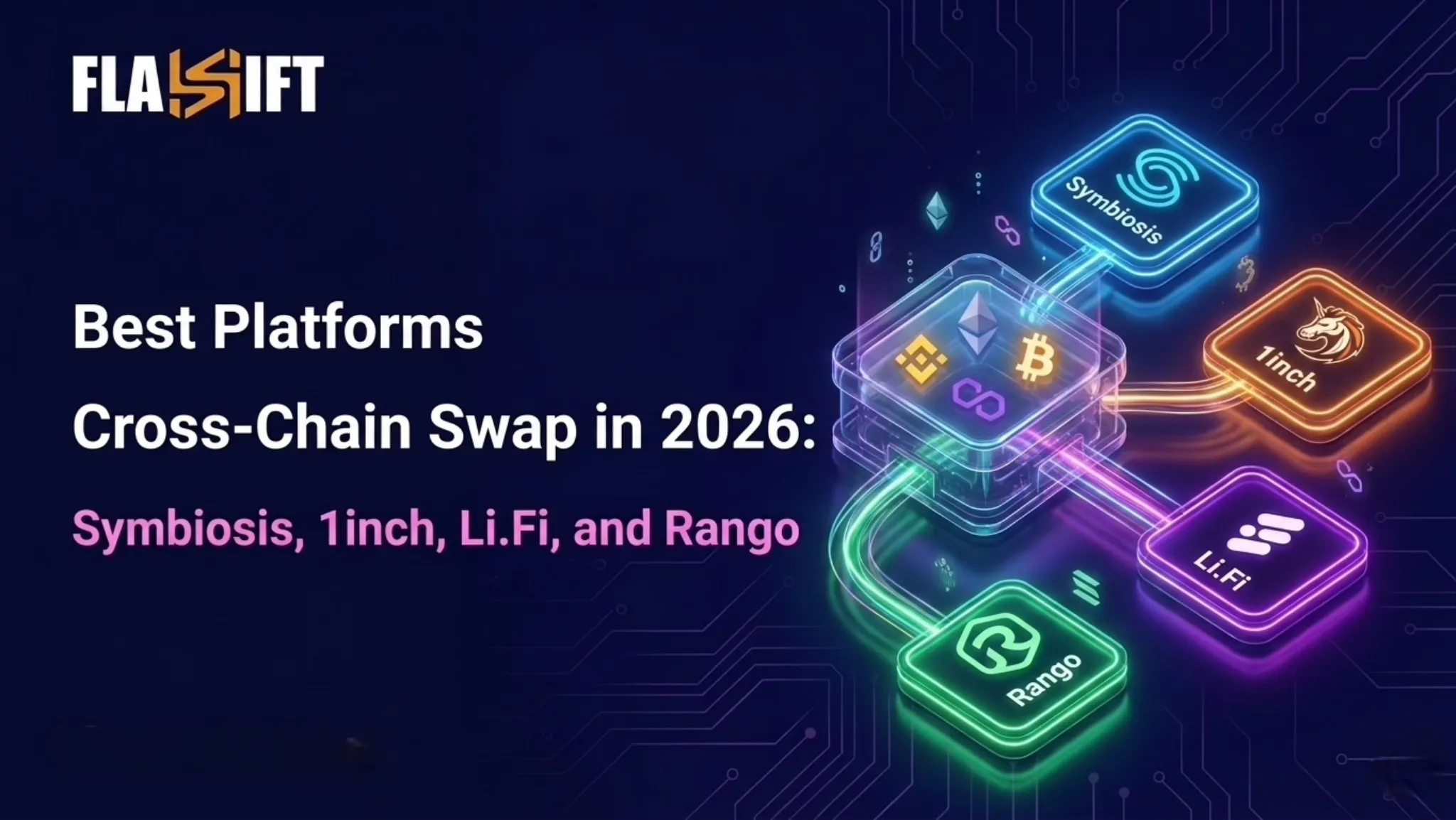
In this guide, we dissect the top cross-chain routing engines of 2026—including Symbiosis, 1inch, Li.Fi, Rango, and the latest generation of unified aggregators. Let’s compare their routing logic, security models, and discover how they achieve true, frictionless interoperability for the sovereign trader.
2026 Cross-Chain Comparison: Efficiency vs. Sovereignty
| Feature | Symbiosis | 1inch | Li.Fi | Rango | Flashift (Top Choice) |
| Security Model | SIS Chain (Hybrid) | DEX Aggregation | Bridge & DEX Aggregation | Multi-Chain Routing | Unified Instant Exchange & DEX Router |
| KYC Requirement (2026) | Partial (None for swaps, but SIS nodes/LPs may face local regs) | Restricted (Front-end blocks in specific Tier-1 regions) | Variable (Depends on the specific bridge used in the route) | Partial (Regional blocks for certain niche chains) | Absolute Zero KYC (Privacy-first, global access) |
| Fee Structure | Low Swap + SIS Fees | Best Execution / Gas Dependent | Multi-hop fees can be high | Varies by Network | Transparent & Competitive |
| Execution Speed | Fast (via SIS Chain) | High (Single-chain) | Efficient but multi-confirmation | Network Dependent | Instant Execution |
| Best For | Balanced Swaps | Price Optimization | Complex Routing | NFT & Gaming Niche | Simultaneous DEX & Non-Custodial Exchange Comparison |
The performance audit makes it clear: relying on legacy infrastructure means exposing your assets to vulnerable lock-and-mint contracts and centralized honeypots. In 2026, the smartest security strategy is not to find a better bridge, but to eliminate the dependency altogether.
Best No-KYC Crypto Swaps UK & EU 2026: MiCAR Guide
Global Swap Volume Dynamics: A Move Toward Security
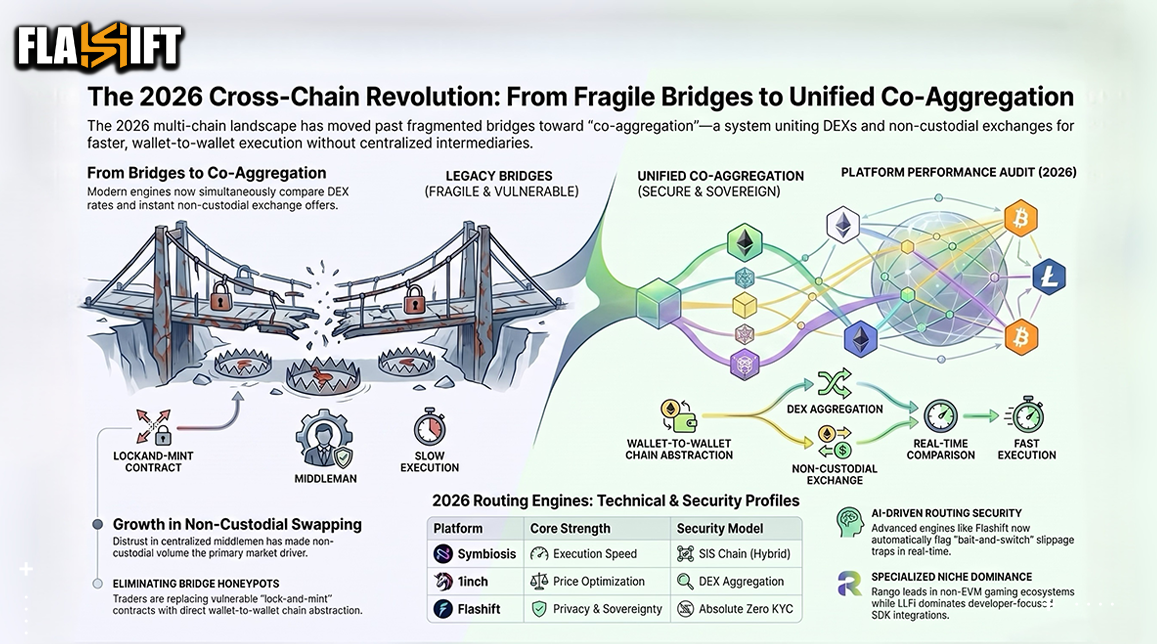
Market data from early 2026 shows a stark shift. Decentralized exchange (DEX) volume continues to outpace centralized counterparts, but the primary growth driver is Non-Custodial Swapping. Traders have realized that leaving funds locked in old “Lock-and-Mint” bridge contracts was a billion-dollar mistake.
This distrust in centralized middlemen has fueled the growth of aggregators that allow for Wallet-to-Wallet Swaps across distinct blockchains. The liquidity is now global, and traders demand tools that keep up with this borderless DeFi landscape without requiring a “Permission Slip” for their own capital.
The liquidity is now global, and traders demand tools that keep up with this borderless DeFi landscape without requiring a “Permission Slip” for their own capital. However, to truly understand why traditional cross-chain routes are becoming obsolete while modern co-aggregation engines succeed, we must look under the hood at the routing infrastructure dominating 2026.
Analyzing the Cross-Chain Routing Engines of 2026
Symbiosis & the SIS Chain: Fast, Hybrid Routing
Symbiosis stands out in 2026 by taking a hybrid approach. It isn’t just a DEX aggregator; it routes swaps through its own dedicated blockchain, the SIS Chain. This chain acts as a decentralized liquidity hub, connecting EVM and non-EVM ecosystems in real time.
What Makes Symbiosis Unique in 2026:
The SIS Chain provides Instant Finality for the internal steps of a cross-chain swap. This means fewer failed transactions and faster execution compared to traditional multi-step bridges.
- SIS Token Utility: In 2026, the SIS token is no longer speculative. It is a functional requirement. It secures the network via staking for liquidity providers (LPs) and is used to pay for cross-chain message fees, reducing reliance on the destination chain’s native gas for the intermediate swap logic.
- LP Edge: Symbiosis offers unique Cross-Chain Yield Opportunities for LPs by pooling SIS with other native assets, reducing liquidity fragmentation across ecosystems.
1inch & Li.Fi: Aggregation Over Infrastructure
In direct contrast to Symbiosis, 1inch and Li.Fi are pure aggregation engines. They don’t want to be the infrastructure; they want to find the most efficient path through any infrastructure.
Read More: Cross-Chain Bridges Explained: How They Work & Which Are Safe
How 1inch Unifies DEX Liquidity across 20+ Chains:
1inch began as a DEX aggregator and by 2026, it is a Gas Price API and multi-chain routing powerhouse. It scans liquidity across hundreds of DEXs on Arbitrum, Optimism, Solana, and beyond, often splitting a single trade into multiple paths to ensure the lowest slippage. For professional traders prioritizing best pricing within a specific chain or EVM L2s, 1inch remains indispensable.
For professional traders prioritizing best pricing within a specific chain or EVM L2s, 1inch remains indispensable. However, because 1inch strictly aggregates DEXs, users seeking cross-chain swaps without wallet connections must still look elsewhere for instant non-custodial solutions.
Li.Fi’s SDK: The Interoperability Portal for Developers:
Li.Fi takes aggregation a step further by integrating both DEX liquidity and 20+ distinct bridges into a single API. By 2026, Li.Fi is less a consumer platform and more the backend infrastructure for wallets, DeFi apps, and other dApps. Its depth of integration allows for advanced multi-hop routing that can move from ETH on Ethereum to SOL on Solana in a single signed transaction. The trade-off, however, is security; routing through 20+ different bridges inherently increases exposure to smart contract vulnerabilities and lock-and-mint exploits.
Read More: The Complete Guide to DEX Trading: How to Use Decentralized Exchanges
Rango Exchange: Niche Network Support (NFT/Gaming)
Rango Exchange carved out a niche as the aggregation champion for less common blockchains. By 2026, while 1inch and Li.Fi dominate EVM liquidity, Rango supports dozens of chains, including:
- EVM Chains: Ethereum, BNB Chain, and Polygon.
- Non-EVM Chains: Solana, Cosmos, and older chains that aggregators often overlook.
- Wallet Agnostic: Its ability to handle non-EVM wallets (e.g., Keplr, Phantom) and EVM wallets (MetaMask) in the same interface makes it unique.
Rango often becomes the go-to platform for traders bridging into niche ecosystems, particularly for NFT Mints or Blockchain Gaming economies on chains like Polygon or Solana. However, this wider reach sometimes comes with higher technical debt and slightly slower confirmation times on smaller networks, and the constant friction of switching between multiple EVM and non-EVM wallets to complete a single route.
Read More: The Next Generation of Cross-Chain Aggregators: Flashift vs Rango vs Li.Fi (2026 Update)
Security, Fees, Speed: The 2026 Performance Audit
| Feature/Risk | Impact on Swaps | Why it Matters in 2026 (Tier-1 GEO) |
| Smart Contract Risk | Symbiosis: Concentrated in SIS Chain. / 1inch: Distributed across 100+ aggregated contracts. / Li.Fi: Exposed to 20+ different bridge contracts. | For US/DE traders, contract auditing is paramount to prevent honeypots. |
| Routing Efficiency | Symbiosis: Direct routing on SIS Chain is faster than multi-step hops. | Essential for arbitrage. |
| Technical Debt | Li.Fi & Rango: High technical debt due to maintaining 20+ bridge integrations. | Increases attack surface and regulatory friction. |
Flashift: The Non-Custodial Sovereign Alternative
If you are ready to cut through the noise of fragmented networks and chaotic multi-hop routes, it is time to streamline your execution. In 2026, professional traders rely on Flashift for four distinct reasons:
- Simultaneous DEX & Instant Swap Co-Aggregation: Unlike standard platforms that only scan one type of liquidity, Flashift now integrates real-time rates from top on-chain DEXs right alongside our trusted instant non-custodial partners.
- Absolute Privacy & Wallet-Free Routing: Flashift respects your financial privacy. Whether you are swapping Ethereum to privacy-focused assets like Zcash (ZEC) or Monero (XMR), our system requires zero KYC and zero wallet connections.
- Elimination of Bridge Honeypots via Chain Abstraction: We do not rely on vulnerable lock-and-mint bridge architecture. By leveraging true Chain Abstraction, Flashift completely hides the underlying complexities of fragmented blockchains from the user.
- AI-Driven Routing & Continuous Post-Trade Analysis: Flashift goes beyond merely finding the best initial rate. Our advanced AI infrastructure performs rigorous, continuous post-trade analysis across all integrated platforms. If the AI detects any partner exchange deploying “bait-and-switch” slippage traps, or identifies a history of sudden, unexpected KYC demands, it automatically flags and removes that provider from the routing path.
Conclusion: The Future of Cross-Chain Swap Platforms
Cross-chain swaps are no longer a niche feature—they’re a cornerstone of the multi-chain economy in 2026. With DEX volume skyrocketing and liquidity scattered across diverse ecosystems, the need for efficient and secure swapping tools has never been greater.
While platforms like Symbiosis, 1inch, Li.Fi, and Rango each offer distinct strengths for specific niches, the industry’s future lies in unified, bridge-free liquidity. With Flashift’s latest protocol upgrade merging DEX protocols and Instant Non-Custodial Exchanges into a single interface, traders no longer have to choose between best pricing, strict privacy, or ironclad security.
To stay ahead in the borderless Web3 economy, eliminate the centralized gatekeepers and streamline your execution. Choose a platform that balances absolute sovereignty with seamless flexibility, and experience the new standard of cross-chain trading with Flashift.
FAQs
Can I compare DEX rates with Instant Non-Custodial Exchanges simultaneously?
Yes. With Flashift’s unified aggregator, the engine actively searches for available offers across both decentralized exchanges (DEXs) and instant non-custodial exchanges (like ChangeHero or StealthEX). It presents the optimal rates within a single interface, allowing you to choose the best option without visiting multiple sites or connecting your wallet.
What are the best cross-chain swap platforms in 2026?
As of 2026, the leading platforms are Symbiosis, 1inch, Li.Fi, Rango, and Flashift. Symbiosis is preferred for its dedicated SIS Chain infrastructure, while 1inch and Li.Fi dominate in aggregation depth. Flashift has emerged as the top choice for traders prioritizing non-custodial security and privacy.
Symbiosis vs 1inch: Which is better?
- Symbiosis is better for beginners who want fast swaps through its SIS Chain with minimal complexity.
- 1inch is better for pro traders seeking the best pricing and advanced routing across multiple DEXs.
Your choice depends on whether you value simplicity or maximized execution efficiency.
How does Li.Fi compare to Rango Exchange?
- Li.Fi integrates with more than 20 bridges and DEXs, making it powerful for multi-chain routing and arbitrage.
- Rango supports a broader variety of blockchains, including non-EVM networks, making it popular for NFT and gaming ecosystems.
Li.Fi is ideal for complex DeFi strategies, while Rango is better for niche ecosystems.
Are cross-chain swap platforms safer than crypto bridges?
Generally, yes. Cross-chain swap platforms reduce exposure to lock-and-mint bridge contracts, which have historically been exploited. Platforms like Symbiosis, 1inch, Li.Fi, and Rango focus on liquidity aggregation and routing instead of custodial token locks, making them safer than centralized or unaudited bridges.
Which platform is best for beginners?
Symbiosis and Rango are the most beginner-friendly because of their straightforward user interfaces and wide wallet support. However, some users prefer Flashift, a non-custodial swap aggregator that simplifies cross-chain transfers even further, removing the need to interact directly with bridges or wrapped tokens.
Which platform is best for professional traders?
Advanced traders often prefer 1inch for best execution and Li.Fi for multi-hop, multi-chain routing. These platforms offer more tools and integrations suited for high-volume trading strategies.
What is the future of cross-chain swap platforms?
In 2026 and beyond, expect AI-powered routing, stronger security standards, and real-world asset tokenization to reshape the cross-chain space. Aggregators like Symbiosis, 1inch, Li.Fi, and Rango will likely evolve further, while non-custodial platforms like Flashift will grow in popularity for users who prioritize security and simplicity.