
In the high-stakes DeFi environment of 2026, professional traders have no patience for “wrapped” assets, synthetic proxies, or the high technical debt of fragmented liquidity. If you are still waiting 20 minutes for a legacy bridge to mint a synthetic version of your collateral, you are actively losing capital to slippage, execution latency, and unnecessary smart contract exposure.
Transitioning your portfolio demands utilizing an automated cross-chain routing gateway to execute swaps with the speed and finality of a single network, completely bypassing the risks of centralized holding periods. Interoperability should be invisible—allowing you to swap assets across isolated blockchains natively without leaving a paper trail.
Comparative Analysis: Benefits vs. Risks in 2026
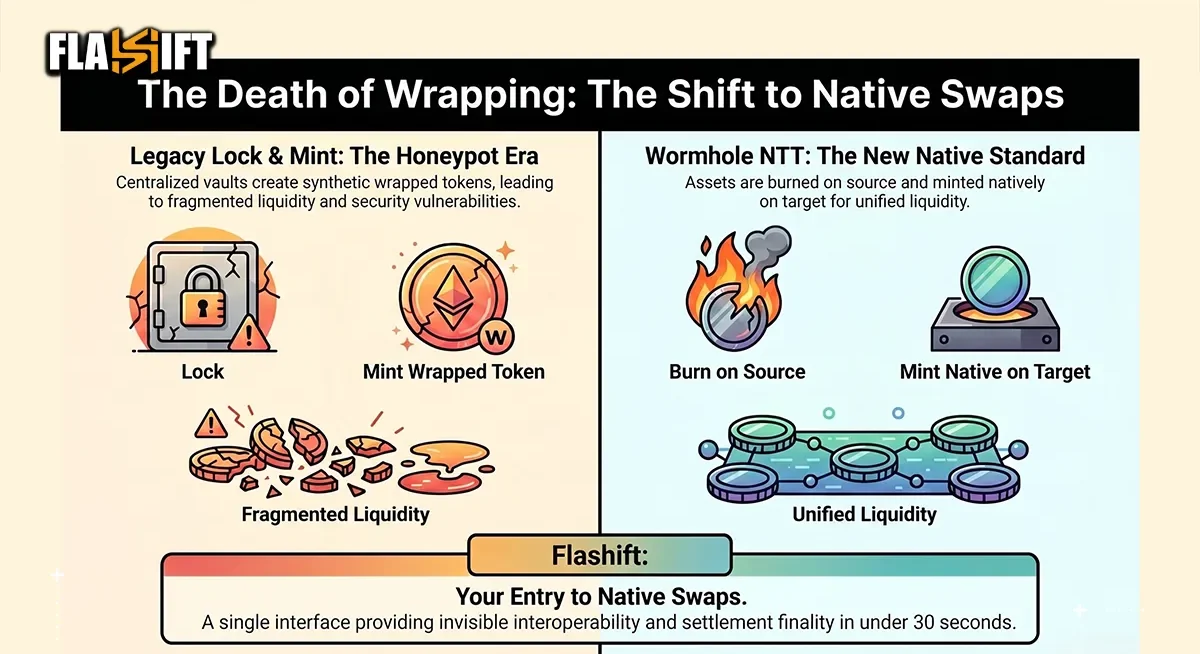
By executing swaps through an intelligent non-custodial cross-chain router, the underlying protocol coordinates the burn-and-mint or lock-and-release of native assets under the hood.
The End of “Honeypot” Risks: Moving Toward Native Liquidity
The old “Lock and Mint” bridge model is now a relic of the past. Why? Because centralized bridge vaults became the ultimate Honeypots for hackers.
In 2026, the standard is NTT (Native Token Transfers). Instead of creating a synthetic “wrapped” token that adds complexity to your portfolio, Wormhole messaging allows tokens to exist natively on every chain. When you swap via Flashift, the protocol coordinates the burn-and-mint or lock-and-release of native assets.
- Result: You receive the real asset on your destination chain, not a proxy.
- Security: Your exposure to bridge-specific vulnerabilities is eliminated.
Invisible Interoperability: How Flashift Powers Your Cross-Chain Swaps
For the Tier-1 trader in the US or Germany, the underlying technology shouldn’t be a hurdle. It should be invisible. Wormhole serves as the Messaging Fabric that settles your trade across the multichain web without you ever leaving the Flashift interface.
The 2026 Swap Efficiency Report:
- Settlement Finality: By utilizing Wormhole’s Guardian Network (19 elite validators), we ensure that once a swap is initiated, the transaction is cryptographically finalized across chains in seconds. No more “pending” anxiety.
- Zero Wrap Fee: Because we utilize native flows, you avoid the hidden costs associated with maintaining and swapping wrapped assets.
- Smart Routing: Flashift’s engine queries Wormhole VAAs to find the most capital-efficient path, ensuring the lowest slippage even in high-volatility markets.
Read More: LayerZero vs Wormhole vs Axelar: Who Will Power the Omnichain Future?
Wormhole’s messaging mechanism is well-suited to NFTs and gaming, though the full ecosystem is still evolving.
Guardian Network: The Security Layer Behind Your Capital
Why do we trust Wormhole for your large-scale swaps? Unlike semi-centralized multisigs, Wormhole’s security is institutional-grade.
- Decentralized Verification: 19 independent Guardians monitor every message. A supermajority (13/19) is required for any action, making collusion virtually impossible.
- Verifiable Action Approvals (VAAs): Every swap on Flashift is backed by a VAA—a tamper-proof proof of transaction that ensures your funds are never “stuck” in a cross-chain vacuum.
FAQs
How long does a cross-chain swap take in 2026?
Thanks to Wormhole’s messaging architecture and Flashift’s optimized routing, most swaps between high-throughput chains (like Solana, Base, or Arbitrum) settle in under 30 seconds.
Are there hidden fees for “Native” transfers?
No. By bypassing the “Wrapping” stage, NTT (Native Token Transfers) reduces gas consumption on the target chain. You pay the standard network fee plus a minimal aggregator fee for the best-market-rate routing.
What happens if a chain goes down during my swap?
This is where the Messaging Fabric excels. Because VAAs are cryptographically stored, your transaction is “state-aware.” If a destination chain experiences an outage, your assets remain secure on the source chain or are automatically settled the moment the target chain resumes.
Do I need to hold the native gas token of the destination chain?
Through Flashift’s Gas-less Swaps (powered by Wormhole relayers), you can often pay for the entire transaction using the asset you are swapping. This is the definition of Invisible Interoperability.