Traders are not looking for philosophical discussions about privacy; they are actively searching for the best ways to shield USDT on Ethereum and protect their on-chain footprints.
In this guide, we dive straight into execution. We will explore how the Railgun privacy protocol’s Ethereum zk-SNARKs architecture shields your smart contract interactions, outline the latest Railgun-supported chains, and reveal a groundbreaking zk tech breakthrough that merges hardware-level security with AI-driven decentralized finance.
The Core zk Tech Breakthrough: AI and Hardware Enclaves
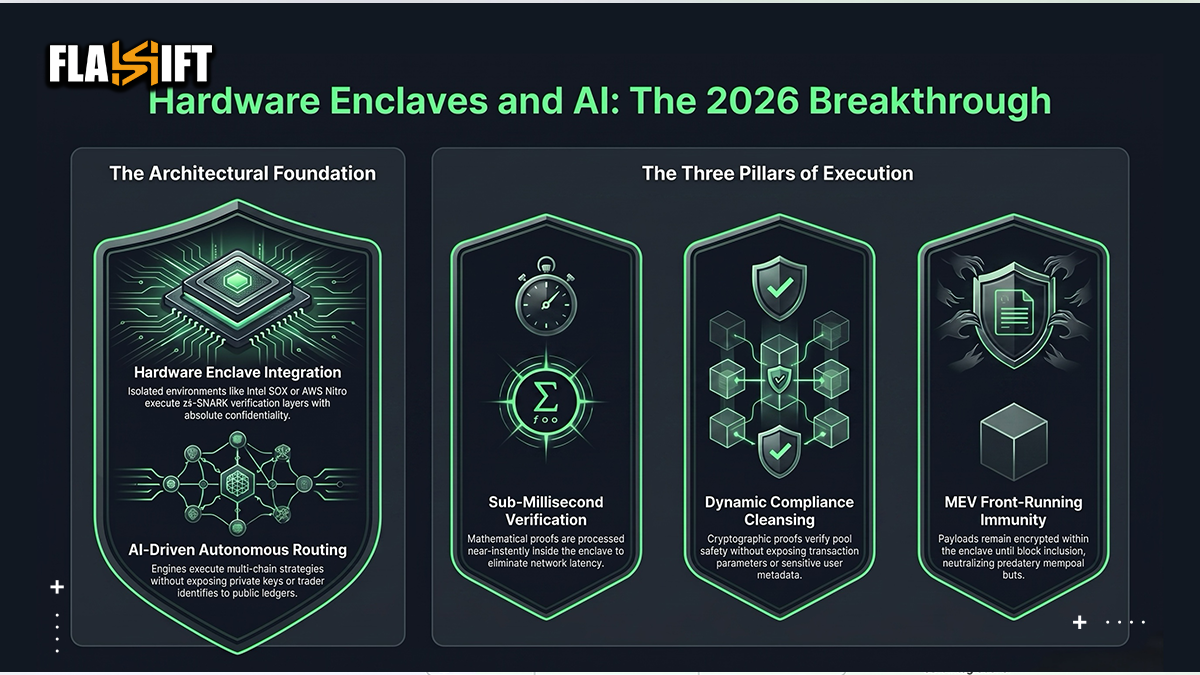
The next evolution of sovereign smart contracts goes far beyond basic zero-knowledge proofs. To achieve absolute, institutional-grade privacy, the infrastructure is shifting fundamentally.
Moving from human-managed vaults to native on-chain key derivation inside secure hardware enclaves is exactly how we get true AI-driven DeFi.
By integrating zk-SNARKs with these secure enclaves, autonomous AI routing engines can execute complex, multi-chain strategies without ever exposing the underlying private keys or the trader’s identity to the public ledger. This ensures that your financial logic remains mathematically verifiable, yet entirely invisible to on-chain surveillance.
Hardware Enclaves and AI: The 2026 Breakthrough
The renaissance of zero-knowledge infrastructure in 2026 is no longer driven by speculative privacy coins, but by a fundamental paradigm shift in core architecture. Moving from human-managed vaults to native on-chain key derivation inside secure hardware enclaves is exactly how we get true AI-driven DeFi.
By running zk-SNARK verification layers inside isolated hardware environments (like Intel SGX or AWS Nitro Enclaves), the execution layer achieves absolute confidentiality. This technical maturity solves three historical friction points for institutional capital:
- Sub-Millisecond Verification: Mathematical proofs that once caused severe network latency are now processed near-instantly inside the enclave.
- Dynamic Compliance Cleansing: Advanced routing systems can run cryptographic compliance proofs to verify a pool’s safety without exposing any transaction parameters or user metadata.
- MEV Front-Running Immunity: Because the transaction payload remains entirely encrypted within the hardware enclave until the exact millisecond of block inclusion, predatory bots cannot peek into the mempool to front-run your trade.
Best Ways to Shield USDT on Ethereum using Railgun
If you are evaluating the best ways to secure and privately route USDT on Ethereum, utilizing a mixer is an outdated and highly risky strategy. The modern standard is using the railgun privacy protocol ethereum zk-snarks system. Instead of mixing funds, Railgun shields your USDT directly inside a smart contract pool. You can then swap, transfer, or deploy that USDT without revealing your wallet address.
As of the latest updates, railgun supported chains have expanded beyond Ethereum to include Polygon, BNB Chain, and Arbitrum, providing massive flexibility for cross-chain privacy.
The Rise of zk-Based Lending Protocols with Privacy
Beyond simple swaps, users are now deploying shielded assets into zk-based lending protocols with privacy. This allows you to collateralize assets and borrow stablecoins while your liquidation thresholds and total portfolio size remain completely hidden from predatory traders and MEV bots.
Portable Confidentiality: Cross-Chain Zero-Knowledge Routing
For years, privacy in decentralized finance was trapped within the artificial boundaries of single isolated networks. While an Ethereum-native privacy contract could successfully shield an asset on-chain, the moment that asset interacted with a cross-chain bridge, the privacy vector was completely shattered by public tracking endpoints.
In 2026, the breakthrough lies in unifying routing pathways rather than relying on asset-locking bridges. Instead of forcing tokens through vulnerable smart contracts that leave public breadcrumb trails across multiple networks, modern systems execute trades via cross-chain co-aggregation. By running zk-proofs natively across the routing handoff, privacy finally becomes portable. This allows capital to flow across distinct ecosystems seamlessly, ensuring that confidentiality survives the transition without compromising on-chain verifiability.
The Next Generation of Anonymous Swaps: Co-Aggregation
Think of legacy decentralized exchanges the way we once viewed unencrypted email; functional by design, but painfully leaky when it comes to financial data protection. Standard AMM trades expose your exact slippage tolerances, wallet linkages, and portfolio balances to public analytics engines, leaving your strategies vulnerable.
The 2026 standard solves this via unified co-aggregation frameworks. By merging on-chain DEX liquidity layers directly with instant non-custodial cross-chain networks, the execution architecture can completely overcome traditional protocol-level KYC constraints. Identity checks become entirely optional, selective disclosures become mathematically precise, and private cross-chain swaps become an operational baseline.
This dual-engine setup provides an uncompromised trading experience: you can safely deploy capital straight into private assets, compare global market depths in real-time, and preserve your financial sovereignty without managing multiple gas tokens or sacrificing execution speed.
🛡️ Opsec Execution Note: Maintaining absolute on-chain privacy requires eliminating centralized entry points and dangerous contract over-approvals from step one. By employing continuous post-trade analysis, Flashift’s AI routing engine instantly detects and filters out exchanges using Bait-and-Switch slippage traps or sudden post-deposit KYC holds. Instead of exposing your cold storage to multiple decentralized platforms, you can utilize Flashift’s unified terminal. The engine aggregates deep liquidity from leading DEXs and instant non-custodial networks simultaneously, allowing you to lock in the optimal exchange rate and complete direct wallet-to-wallet transactions with zero registration and zero mandatory KYC holds.
Sourcing Privacy: How to Acquire Anonym Zcash (ZEC) Safely
Before you can utilize Railgun or advanced zk-protocols, you often need to fund your operations or build a baseline privacy portfolio with native assets like anonym zcash (ZEC). Utilizing centralized exchanges for this first step completely defeats the purpose, as your initial acquisition will be tied to your KYC identity.
🛡️ Sovereign Execution Checkpoint: To maintain absolute opsec (operational security) from step one, acquire your privacy coins through a unified co-aggregator. Flashift allows you to swap any native asset directly into Zcash (ZEC) or shield-ready Ethereum by scanning both DEXs and Instant Non-Custodial exchanges simultaneously. Execute your trade with zero KYC, zero wallet-connection vulnerabilities, and guaranteed optimal rates before deploying into zk-DeFi.
FAQ
- Why are privacy tools like Railgun and Zcash suddenly back in the spotlight in 2025?
Because the crypto landscape has matured. Institutions and serious traders now care about data protection just as much as decentralization. Railgun’s smart contract privacy and Zcash’s refined zk-SNARKs are showing that anonymity can coexist with compliance, making them relevant again in the privacy-first wave of DeFi.
- How does zk technology actually improve on-chain privacy without breaking transparency?
Zero-knowledge proofs let a transaction prove it’s valid without revealing any of its details. This means networks stay verifiable while shielded transactions hide amounts, senders, and receivers. It’s like showing your ID without revealing your name.
- What makes Railgun different from earlier privacy protocols?
Unlike older mixers or stealth systems, Railgun crypto operates within smart contracts. It uses zk-proofs to create private balances and swaps directly on-chain. In other words, users can interact with DeFi apps normally—but their transaction data stays invisible to everyone else.
- Are zk-based privacy systems compatible with regulatory frameworks?
Yes, and that’s part of what makes zk technology in 2025 so powerful. Selective disclosure allows users to reveal specific transaction proofs when needed, satisfying audits or compliance checks without exposing the rest of their activity.
- What’s next for privacy DeFi beyond Railgun and Zcash?
We’re moving toward cross-chain privacy—a future where assets can move privately between blockchains without losing anonymity at each hop. Expect upcoming DEXs and bridges to integrate zk systems as standard, making anonymous crypto trading seamless and interoperable across ecosystems.