
Privacy is no longer a luxury; in 2026, it is a survival skill. With CBDC pilots rolling out across Europe and Asia, the “glass house” economy is here. Every transaction you make on a transparent chain (like Bitcoin) or a centralized exchange is logged, scored, and monitored. But for every measure of surveillance, there is a counter-measure of sovereignty. Privacy assets are not dead. They just moved underground, and they are stronger than ever. Here…
The XRP ETF surge is gaining pace. Bitwise announced the launch of its new XRP fund, calling it a major leap for the world’s third-largest crypto asset and its mission to redefine global payments. You’ve held the the world’s third-largest crypto asset before, watched the headlines. Now you’re wondering: “What’s really changed?” The answer lies in the latest entry in the crypto-ETFs landscape: the first-ever spot XRP ETF, giving regulated access to XRP in a…
Most people in DeFi still treat privacy like an optional extra, right up until the moment their entire trading history is sitting on a block explorer for anyone to dissect. Railgun steps into that gap with something far more substantial than another mixer or “privacy trick.” It bakes zero-knowledge proofs straight into on-chain logic, giving traders and capital allocators a real shield without leaving the Ethereum ecosystem. For anyone trying to understand Railgun explained in…
Dash in 2025: Can the Original Payment Coin Compete with New Privacy Projects? | When Dash was launched in 2014, its ambition was clear: “To become genuine “digital cash”; payments that are fast, cheap, global and simple. Over time the project kept innovating. It introduced features like masternodes, InstantSend for near-instant confirmation, and PrivateSend, an optional mixing function designed to provide users with some level of anonymity. Fast-forward to 2025, and the world of privacy-oriented…
Dash vs Zcash | In a digital world, privacy is no longer just a motto, it’s a strategic edge. You’ve just wrapped your week’s freelance projects, your client pays in crypto — but you don’t want your payment sitting on a centralized exchange. You need speed, privacy, and control. That’s where the crossroads appear: DASH and ZCASH, each representing a different philosophy of financial freedom. In this cast, we compare Dash (DASH) and Zcash (ZEC)…
In the evolving world of digital assets, the spotlight in 2025 is increasingly on transactional privacy—and three projects in particular are carving distinct paths: Dash (DASH), Railgun (RAIL), and Zano (ZANO). Dash, once known for its payments-first design, still offers its built-in PrivateSend mix feature to conceal transactions. Railgun brings next-gen zero-knowledge proof tech to the DeFi world, enabling any on-chain contract to shield senders, recipients and amounts. Meanwhile Zano stands out as a privacy-first…
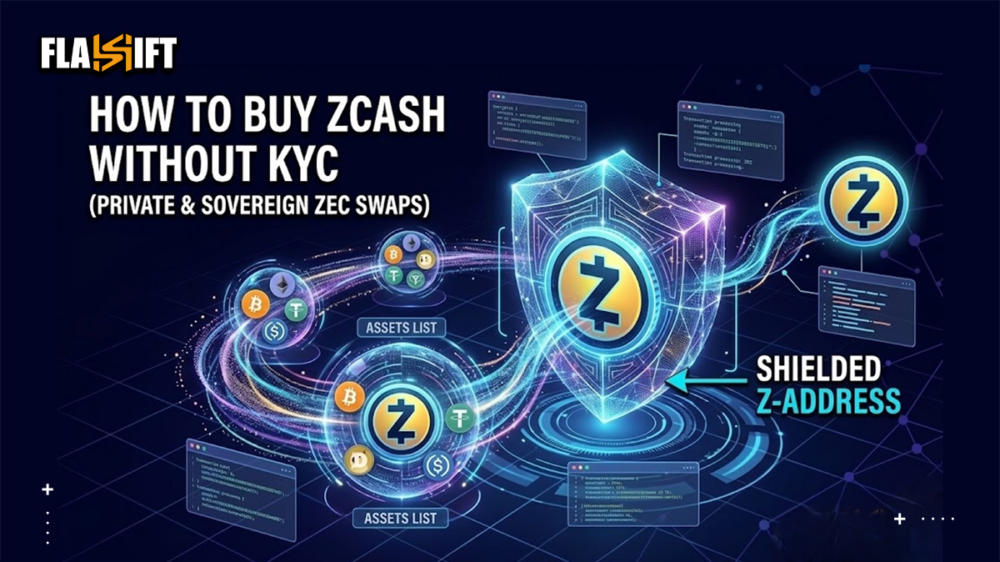
Swap Zcash (ZEC) without KYC: You’re holding Zcash (ZEC) because you value transaction privacy. Now, in 2025, as KYC rules tighten globally, you wonder: “How do I swap ZEC without handing over my ID?” The good news: you can still perform a private ZEC swap—if you use the right tools. This article walks you through how to swap ZEC privately, why a Zcash exchange anonymous model matters, and step-by-step how we do it on Flashift…
In 2025, the debate of Monero vs Zcash is more relevant than ever. As regulators tighten their grip on crypto privacy and blockchain analysis tools grow sharper, the demand for truly anonymous transactions hasn’t faded—it’s evolved. Monero and Zcash still lead the pack, but their paths remain starkly different. Monero’s ring signatures and stealth addresses keep every transaction hidden in a web of decoys, while Zcash’s zk-SNARKs bring a more mathematical, cryptographic approach—encrypting data so…
Have you seen how a U.S. government data initiative just turbocharged Wormhole’s token rally? When a government agency like the U.S. Department of Commerce steps into blockchain, the market pays attention. That’s exactly what happened last week when the Commerce Department announced that Pyth Network would start verifying and distributing official economic data — like GDP figures — directly on-chain. Wormhole’s token shot up nearly 25% in a matter of days, fueled by the recognition…
Synthetic Assets | Imagine trading Tesla stock, gold, or the U.S. dollar—without ever leaving the blockchain. That’s the promise of synthetic assets, and by 2025, they had become one of the fastest-growing frontiers of decentralized finance (DeFi). Synthetic assets are digital tokens that replicate the value of real-world assets, ranging from equities to commodities and currencies, utilizing smart contracts and on-chain collateral. They’re the foundation of on-chain derivatives, giving crypto users exposure to traditional markets…