
If you hold privacy coins on a centralized exchange, your capital is in immediate danger. Aggressive MiCA and FATF mandates have triggered a wave of privacy coins regulatory risks delisting in 2026. Leaving your privacy assets on these custodial platforms now guarantees sudden account freezes, mandatory proof-of-source interrogations, and total liquidity lockups.
Privacy is not dead; it has simply migrated to sovereign, decentralized execution layers. You do not have to surrender your assets or your identity.
By utilizing a Zero-Approval non-custodial aggregator like Flashift, you can instantly remove the frictions of centralized exchanges. Execute direct wallet-to-wallet swaps between XMR, ZEC, BTC, and USDT in under 3 minutes with zero account registration and zero metadata retention.
The 2026 Regulatory Hit List: Who is Banning What?
The institutional crackdown on privacy-enhancing assets is no longer a forecast; it is an active enforcement across major economic zones:
| Jurisdiction | Regulatory Action | Current Market Status (2026) |
| European Union (MiCA) | Explicit ban on anonymity-enhancing coin listings for CASPs. | Full Enforcement. XMR and ZEC are delisted from all EU-licensed centralized platforms. |
| South Korea & Japan | Mandatory restriction of privacy-enabled token trading. | Total Prohibition. Centralized local order-book liquidity is effectively zero. |
| United States | Indirect pressure via banking frameworks and strict AML mandates. | De Facto Restrictions. Major platforms pre-emptively delist tokens to preserve core operational licenses. |
| Australia | Restrictions on fiat on-ramps for privacy-enabled wallet architectures. | Restricted Access. Traditional banking rails monitor outbound transfers to known privacy protocols. |
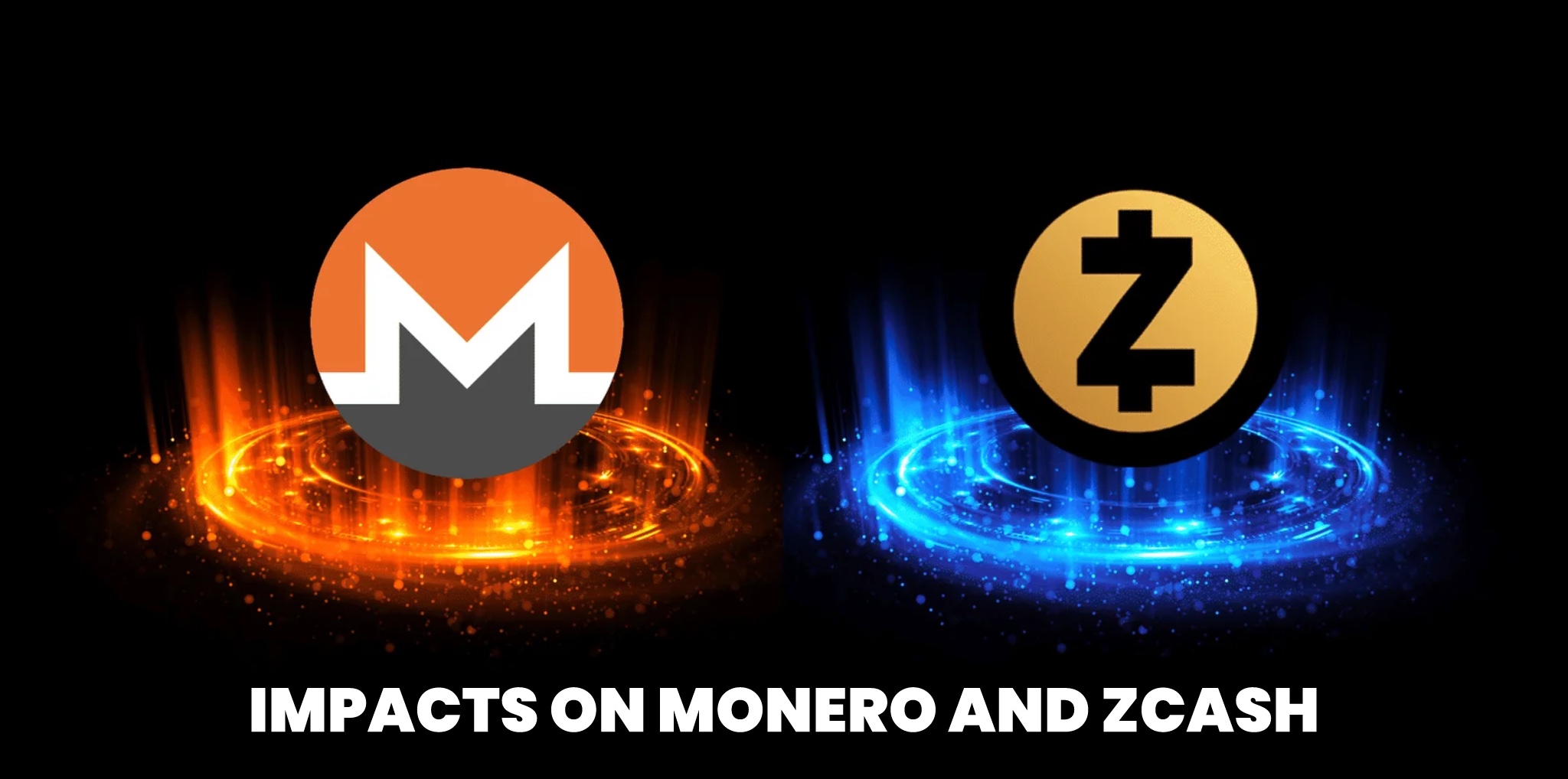
⚖️ Monero and Zcash: Regulatory Risks & Execution Strategies (2026)
Understanding the technical architecture of your privacy asset determines your exposure to the regulatory risks surrounding privacy coins in 2026. Here is how to navigate the crackdown:
- Monero (XMR): Default Privacy & Total Delisting
- The Risk: Because Monero’s architecture (RingCT + Stealth Addresses) cannot be audited by a third party, recent regulatory updates in 2026 have forced major global exchanges to remove all XMR trading pairs entirely.
- The Sovereign Exit: Never send XMR to a centralized platform. Route your capital through Flashift’s multi-chain engine to seamlessly swap XMR for liquid assets (USDT, BTC) directly into your cold storage.
- Zcash (ZEC): The Shielded Pool Bottleneck
- The Risk: When evaluating Zcash’s regulatory risks in 2026, you must examine its optional privacy. While transparent addresses (t-addresses) temporarily survived, compliance mandates are now aggressively targeting and delisting platforms that support shielded pools (z-addresses).
The Sovereign Exit:Store long-term capital in shielded pools, but utilize non-custodial co-aggregators to swap ZEC into compliant stablecoins when you need fluid cross-chain mobility
This is a full guide for swapping Zcash: How to Swap Zcash (ZEC) Without KYC
💵 Is There a Blockchain That Works Like cash, private by default but still legal to use?
Yes. In the digital realm, Monero (XMR) remains the closest technological equivalent to pure physical cash. It is private by default, untraceable, and settles instantly without third-party surveillance.
Holding and self-custodying privacy coins remains 100% legal for individual users in most global jurisdictions. The current regulatory restrictions apply exclusively to custodial financial intermediaries (like centralized exchanges), not to your sovereign right to hold private cryptographic keys.
Portfolio Survival Strategy: The Non-Custodial Routing Loop
When your local region or exchange delists your assets, you have three choices: surrender your privacy, lose your liquidity, or automate your exit.
DEXs and Atomic Swaps: The Hard Way
While theoretically trustless, native cross-chain atomic swaps often suffer from fragmented liquidity, high network gas fees, and steep technical complexity. A stalled trade during network volatility can tie up capital in timelock contracts for hours.
TNon-Custodial Co-Aggregation (The Flashift Standard):
Operating as a Chain Abstraction layer, co-aggregation concurrently scans decentralized liquidity pools to secure optimal rates. You achieve the execution speed of an exchange with the security of decentralized self-custody—swapping restricted assets into liquid stables without registration.
⚡ Execute Your Sovereign Swap: Advanced OpSec Terminal
Your financial sovereignty depends on eliminating centralized dependencies. Before swapping, ensure you isolate your deposit footprints (never reuse wallet addresses) and utilize a VPN or Tor to eliminate node IP logging.
🛡️ Zero-Approval Privacy Execution: Flashift operates as a pure Chain Abstraction layer. We never request dApp wallet connections or token spending signatures.
Instantly swap XMR, ZEC, and ZANO against BTC, ETH, and USDT strictly via an isolated, single-use deposit address. Our AI routing engine performs continuous post-trade analysis to automatically blacklist providers with predatory spreads, ensuring you receive the exact quoted rate without hidden slippage. Execute your private swap below in under 3 minutes.
FAQ:
Is it illegal to own Monero (XMR) in 2026?
In most western jurisdictions, ownership is not illegal, but service providers (exchanges) are forbidden from helping you trade it. You are responsible for your own liquidity.
What’s the difference between Monero and Zcash regarding regulation?
Monero is built for privacy by default, which increases regulatory risk because traceability is tough. Zcash offers optional privacy (shielded vs transparent transactions), giving it somewhat more regulatory flexibility—but it still faces listing and compliance headwinds.
If major exchanges delist privacy coins, what can users do?
Users can turn to decentralised exchanges (DEXs), peer-to-peer platforms or swap services that support multi-chain and non-custodial usage. These carry their own risks (liquidity, user experience, compliance), but they provide alternatives.
Will privacy coins disappear under new regulation?
Not necessarily. Many industry observers believe two paths exist:
-
They migrate to niche, decentralised rails with minimal regulation, or
-
They evolve into “privacy-compliant” assets with audit-friendly features and regulatory alignment.
The future depends on how well projects, platforms and regulators adapt.