

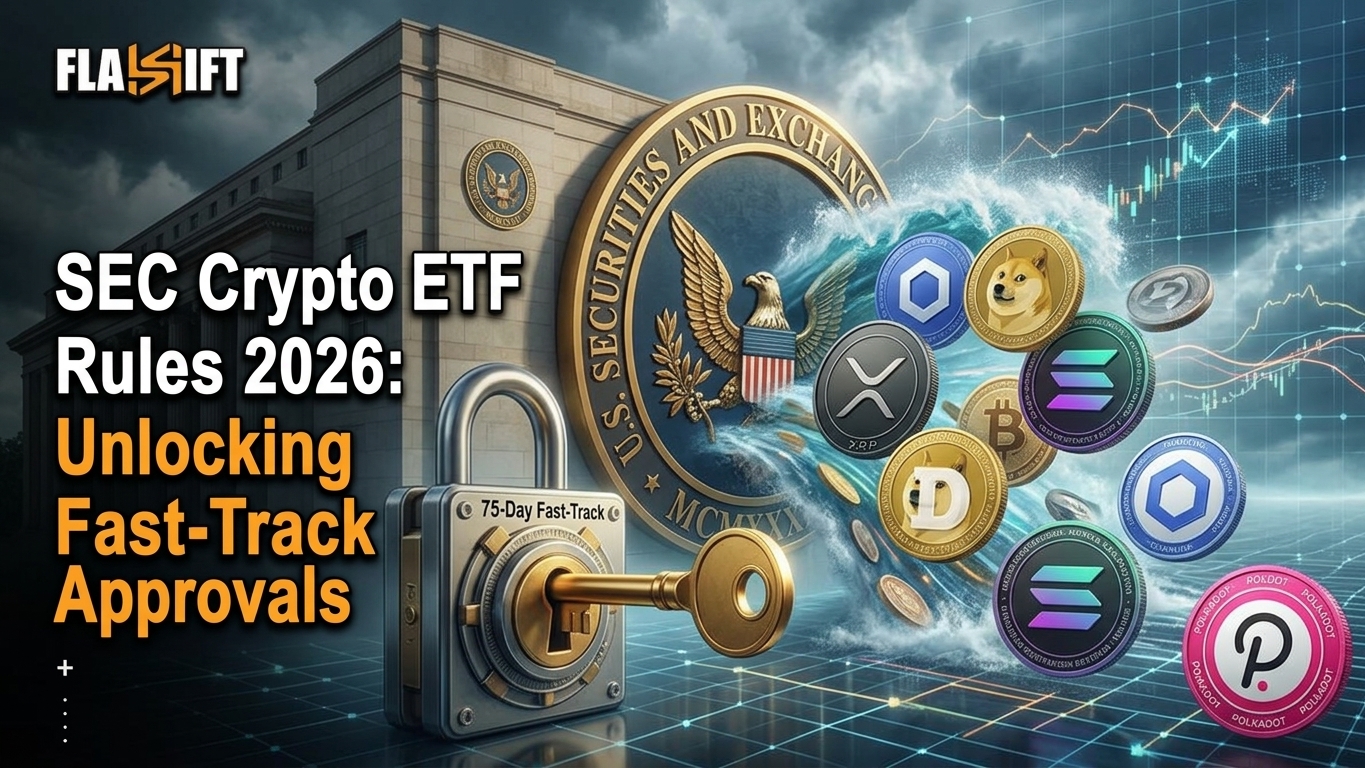
The SEC’s regulatory transition has opened the floodgates for altcoin ETFs. While institutional funds wait in bureaucratic queues to launch custodial wrappers, advanced crypto operators are already accumulating the underlying native assets directly.
Buying an ETF on Wall Street means management fees, trading-hour limitations, and forced identity verification. The winning strategy is capturing the upside of the approval narrative on-chain before institutional liquidity compresses the spread. Here is the operational breakdown of the 75-day generic listing pipeline and how to position your portfolio directly in self-custody.
⚡ The 75-Day Fast-Track: How the SEC Streamlined Altcoin Listings
Under the standardized generic listing rules, qualifying digital asset exchange-traded products (ETPs) bypass the legacy Rule 19b-4 bespoke review process:
- Review Window Compression: Filing reviews that previously stretched beyond 240 days now resolve in approximately 75 days for assets meeting core surveillance criteria.
- In-Kind Redemption Rails: Issuers can create and redeem shares using the native cryptographic asset rather than mandatory cash settlements, drastically improving structural market efficiency.
- The Pipeline: Ripple (XRP) and Dogecoin (DOGE) established the precedent, paving the way for high-throughput networks—specifically Solana (SOL), Chainlink (LINK), and Polkadot (DOT).
ETF | In-Kind Creation & Redemption Permitted
Previously, approved crypto ETFs were limited to cash-only redemptions and creations—forcing issuers to handle complicated arbitrage mechanisms or liquidity stress during large flows. In 2026, the SEC relaxed that restriction, allowing “in-kind” creations/redemptions (i.e., using the underlying crypto itself).
This shift brings crypto ETPs closer to the model used by traditional commodity or equity ETFs, improving structural efficiency, reducing operating costs, and aligning incentive mechanisms better for market makers.
Read More: Crypto Exit Strategies: Taking Profits and Moving to Gold-Backed Assets
Conditional Qualification Criteria & Fast-Track Paths
Even under the new listing regime, not all tokens will qualify immediately. The SEC set thresholds and conditions for eligibility:
- The underlying asset should already trade on a regulated market or have an established futures market regulated by the CFTC for a sufficient duration.
- Alternatively, an existing ETF for that asset (or a derivative thereof) must hold a minimum percentage (e.g. 40% direct exposure) so that new entrants can piggyback on precedent.
- Products that don’t meet these standards must still go through the traditional 19(b) / case-by-case review.
What this does is create a tiered approval process: altcoins that already have market infrastructure and liquidity may fast-track, while newer or less liquid tokens will face a more measured path.
Read More: Ripple (XRP) ETF Explained: Everything You Need to Know
Broader Agenda: Custody, Fund Structures & Crypto Framework
Beyond ETF listings, the SEC signaled reforms in related areas:
- The agency is considering amendments to custody rules and how crypto assets are held within advisory client accounts and funds.
- The “dual share class” structure—allowing a fund to have both mutual fund and ETF classes—is being approved in certain cases, enabling more flexibility in fund design.
- In its 2026 regulatory agenda, the SEC is pacing out a broader “crypto asset framework,” which may include structural definitions, disclosure rules, and more.
These 2026 rule changes represent the most concerted effort yet by the SEC to build a viable, scalable infrastructure for SEC crypto ETF rules 2026. The door for altcoin ETF approval is no longer a theoretical possibility—it’s opening. The question now is which assets qualify, how fast issuers move, and how investors respond.
How Listing Standards Cut Delays
One of the most dramatic shifts under SEC crypto ETF rules 2026 is in how exchanges list new ETPs/ETFs—and how that change slashes approval delays. The new framework establishes generic listing standards, meaning that if a crypto or commodity-based product meets certain preset criteria, it can be listed without needing a separate, bespoke approval by the SEC.
From 240 Days to ~75 Days
Under the old regime, every proposed ETF (or ETP) tied to crypto required a pair of filings: one from the issuer and one from the exchange, typically via Rule 19b-4 under the Securities Exchange Act. Each of those would be scrutinized for compliance, market surveillance, fraud prevention, etc. That process often stretched into 240 days (or even longer).
With generic listing standards in place, an exchange can proceed to list a new product within a much tighter window—about 75 days from submission—so long as the asset and structure satisfy the eligibility rules. This compresses not just time, but regulatory uncertainty and resource burdens.
What the Criteria Look Like
An ETP aiming for this fast track must meet one of several paths:
- Surveillance / trading venue standard: The underlying commodity (or crypto asset) must trade on an exchange that is part of the Intermarket Surveillance Group (ISG). The listing exchange needs surveillance-sharing agreements.
- Futures market requirement: The underlying asset should underlie a futures contract that’s traded on a CFTC-regulated designated contract market (DCM) for at least six months, with appropriate surveillance connections.
- ETF exposure fallback: If there’s already an ETF that holds at least 40 % of its net asset value in that commodity/asset, then new ETP/ETF products using the same asset may qualify under the generic standard.
If a product doesn’t satisfy any of these criteria—especially if it’s leveraged, inverse, or has novel features—it still must go through the old slow route (SEC review under 19b-4).
Why This Matters for Altcoin ETF Approval
Because of these new rules:
- Issuers of altcoin ETFs no longer have to wait months in regulatory limbo if their token already meets the eligibility thresholds.
- The predictability of which assets qualify (via surveillance, futures, or precedent holdings) reduces the legal and operational uncertainty issuers faced.
- Market innovation becomes more efficient: rather than negotiating case by case with the SEC, issuers can design products around known criteria and accelerate deployment.
In short: these listing standards turn the SEC’s gatekeeping from a custom bottleneck into a more rules-based, transparent process, greatly accelerating the path to altcoin ETF approval under the new SEC crypto ETF rules 2026.
Ripple & Dogecoin as first wave
Ripple (XRP) and Dogecoin (DOGE) are shaping up to be the first real test cases for how far the SEC’s new framework for digital asset funds can go. Under the SEC crypto ETF rules 2026, both tokens have found themselves in a unique position—XRP with the regulatory clarity it earned after years of courtroom battles, and DOGE with the massive retail and institutional interest that refuses to fade. Ripple’s partial victory against the SEC removed one of the biggest barriers to entry: uncertainty.
Once that fog lifted, ETF issuers didn’t hesitate. They began drafting filings for XRP-backed funds almost immediately, using the new generic listing standards to bypass much of the red tape that slowed previous crypto applications. For Ripple, this wasn’t just another regulatory milestone; it was the green light that could redefine how altcoins integrate into the traditional financial ecosystem.
Dogecoin’s story couldn’t be more different, yet it mirrors the same transformation. What started as a joke in the early days of crypto has matured into a top-traded digital asset with genuine institutional attention. The push for DOGE ETF under the SEC’s updated framework underscores how far the market has evolved.
The Commission, once quick to reject anything outside Bitcoin or Ethereum, is now cautiously but noticeably more open to broader crypto exposure—so long as it fits the new rulebook. XRP and DOGE, two coins born from entirely different origins, now represent the same turning point: the moment where altcoins stop being speculative side projects and start becoming legitimate, regulated financial instruments.
• Read More About: Ripple and Doge ETFs
Next Candidates: Solana, Chainlink, and Polkadot
After the dust settled around XRP and Dogecoin, attention naturally turned to the next logical contenders under the SEC crypto ETF rules 2025. The momentum behind altcoin ETF approval is now shifting toward projects that combine strong fundamentals with institutional readiness — and few fit that description better than Solana, Chainlink, and Polkadot.
These are not speculative plays riding a hype cycle; they are established networks with real-world adoption, transparent tokenomics, and measurable liquidity. That’s precisely what the SEC’s updated standards are rewarding this time — assets that behave less like experiments and more like sustainable financial instruments.
Of the three, Solana ETF proposals are leading the pack. The network’s unmatched transaction speed and expanding DeFi ecosystem have given it both market depth and credibility — the two metrics regulators care about most. Polkadot ETF applications are also gaining quiet traction, largely because of its role in connecting blockchains — a narrative the institutional market understands well.
And while Chainlink may not move as fast toward ETF listing, its deep integration across the crypto landscape makes it a likely follow-up once liquidity thresholds are met. In short, under the SEC crypto ETF rules 2026, these assets represent the evolution from speculative tokens to structured, tradable investment products — the kind Wall Street can finally take seriously.
📊 Native Asset Ownership vs. Wall Street Spot ETFs
| Feature | Holding Native Tokens | Holding Regulated Spot ETFs |
| Trading Access | 🟢 24/7/365 On-Chain Execution | 🔴 Restricted to Traditional Market Hours |
| Custody & Sovereignty | 🟢 100% Self-Custodial (Your Keys) | 🔴 Third-Party Institutional Custodians |
| KYC Friction | 🟢 Zero-Approval / No Identification | 🔴 Invasive Brokerage Verification & Tax Tracking |
| DeFi Composability | 🟢 Stakeable, Farmable, Deployable | 🔴 Static Paper Exposure (0% On-Chain Utility) |
| Slippage & Spreads | 🟢 Real-time AI Multi-DEX Routing | ⚠️ Management Fees + Broker Premium Spreads |
⚡ Execute Your Strategy: Front-Run Institutional Filings
Institutional ETF capital takes months to deploy through custodial clearinghouses. By the time a spot ETF begins public trading, the initial alpha has already been priced in.
🛡️ Sovereign Trade Terminal: Flashift operates as a pure Chain Abstraction layer with Zero-Approval architecture. Never connect your primary Web3 wallet or expose private data to custodial platforms.
Instantly swap BTC, ETH, or USDT into native XRP, SOL, DOGE, or DOT using isolated, single-use deposit addresses. Our AI routing engine performs continuous post-trade analysis to counter predatory bait-and-switch spread behavior from liquidity providers, delivering fixed quotes directly to your private cold storage.
FAQ
- Why hold native altcoins instead of waiting for spot ETF approval?
Native tokens grant complete financial sovereignty, continuous on-chain utility (staking, lending), and 24/7 liquidity access, completely avoiding the management expense ratios and custodial freeze risks inherent to institutional ETFs.
- Which altcoins are prioritized under the SEC generic listing rules?
Tokens with established CFTC-regulated futures markets or existing multi-market surveillance agreements—primarily Solana (SOL), Ripple (XRP), and Dogecoin (DOGE)—benefit directly from the accelerated 75-day review process.
3. Can I swap into ETF-candidate tokens without KYC?
Yes. Using non-custodial aggregators like Flashift allows you to trade transparent assets like USDT directly for SOL, XRP, or DOT without submitting personal identification, keeping your market entries fully decentralized.